
Field guide · Men’s aviators
Aviator Sunglasses for Men: A Field Guide to What They Can Actually Handle
Most guides judge aviators by how they look. This one checks them against an ordinary week — the commute, the yard, the boat ramp, the range — and is plain about where an everyday pair stops being the right tool.
The short version
- Every pair of sunglasses sold in the US has to pass the FDA’s drop-ball impact test. That is not a safety-glasses rating. Behind a string trimmer, a chainsaw, a grinder or at a range, you want Z87+ printed on both the frame and the lens.
- Whether aviators stay on is decided mostly by the temple ends and the nose pads, not the size. Skull temples hold for normal days, cable temples hold best when you move, and bayonet temples slide under headsets and hat bands.
- For driving and all-round wear, the lens the FAA steers pilots toward — neutral gray, mid-dark, not polarized — is a sound starting point. On the ground, polarized becomes a real option: great on water, with a trade-off on screens.
The aviator started life as work equipment. Today, most aviator sunglasses for men spend their days on the drive to work, at a ballgame, or out in the yard on a Saturday. That gap is where the buying mistakes happen. A guy picks a pair for how it looks, then wears it to edge the lawn, or bends over to grab a cooler and watches it hit the tailgate.
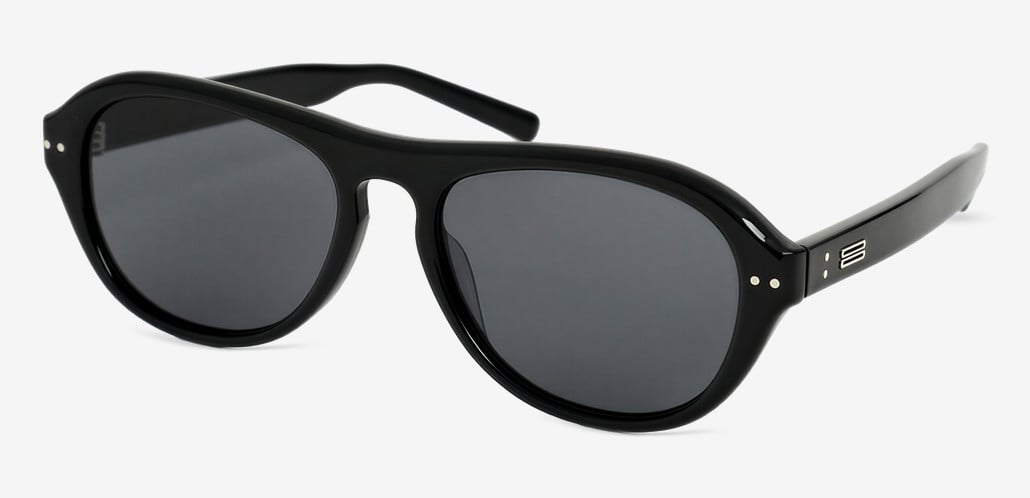
So this guide skips the face-shape charts and the history lesson. It answers the three questions that decide whether a pair works for you: what it’s rated for, whether it stays put when you move, and which lens fits the light you’re actually in. The numbers come straight from the rules that govern American eyewear — the FDA’s impact regulation, ANSI Z80.3 for sunglasses, ANSI/ISEA Z87.1 for safety eyewear, OSHA’s eye-protection rule, the military’s ballistic spec and the FAA’s guidance for pilots — plus a count of our own men’s collection as it stood on November 4, 2026.
The Rating Line: what your aviators are rated for, and what they aren’t
Here’s the part almost no sunglasses guide brings up. In the US, impact resistance comes in rungs, and each rung has its own test. Everyday aviator sunglasses for men sit on the first one. Safety glasses don’t start until the second.
-
Rung 1 · Everyday
Sunglasses and regular glasses
- Rule
- FDA regulation 21 CFR 801.410 requires impact-resistant lenses in all eyeglasses and sunglasses sold in the US. ANSI Z80.3-2018 is the voluntary standard written specifically for nonprescription sunglasses.
- Test
- A 5/8-inch steel ball, about 0.56 oz, dropped from 50 inches onto the center of the lens.
- Mark
- Nothing on the frame for you to check.
-
Rung 2 · Basic impact
Z87 safety eyewear
- Rule
- ANSI/ISEA Z87.1, the standard OSHA’s workplace eye-protection rule (29 CFR 1910.133) points to.
- Test
- A 1-inch steel ball dropped from 50 inches.
- Mark
- Z87 on the frame and the lens.
-
Rung 3 · High impact
Z87+ safety eyewear
- Rule
- The high-impact level of the same ANSI/ISEA Z87.1 standard.
- Test
- A 1/4-inch steel ball fired at 150 feet per second (about 102 mph), plus a 1.1-lb (500 g) pointed weight dropped 50 inches onto the glasses mounted on a test head.
- Mark
- Z87+ on the frame, the maker’s mark plus + on the lens. Rx safety frames read Z87-2+.
-
Rung 4 · Ballistic
Military-rated eyewear
- Rule
- MIL-PRF-32432, the military’s combat eyewear spec. Approved models appear on the US Army’s Authorized Protective Eyewear List (APEL).
- Test
- A 0.15-caliber, 5.8-grain projectile at roughly 640–660 feet per second; a later revision raised the spectacle test to 700–725.
- Mark
- The maker’s test documentation or an APEL listing.
FDA test · Rung 1The ball is dropped.
Z87+ test · Rung 3The ball is fired.
Two things follow from that. First, a pair can be perfectly good sunglasses and still be the wrong thing to wear behind a trimmer. ANSI Z80.3 says as much: its scope leaves industrial safety eyewear to Z87.1. Second, the mark is the only proof. If you can’t find Z87 on the temple and the lens, the pair isn’t rated, whatever the listing calls it.
Aoolia’s aviators are everyday sunglasses. None of them carry a Z87 mark, and none should stand in for safety eyewear.
The Weekend Task Sheet
Use this to sort your week. The right-hand column comes from the instructions that ship with the tools and from the standards themselves, not from us.
| Task | Minimum | Where that comes from |
|---|---|---|
| Commuting, road trips, errands | Everyday | No eye-protection rule applies. This is the job sunglasses are built for. |
| Beach, ballgame, cookout, airport | Everyday | Same as above. |
| Walk-behind or riding mower | Z87 with side shields; Z87+ preferred | Mower manuals commonly call for eye protection marked to comply with ANSI Z87.1, because blades throw stones, wire and glass. University extension guidance suggests Z87+ for lawn equipment. |
| String trimmer, edger, brush cutter | Z87+ with side shields | Trimmer manuals name thrown debris as the leading cause of injury with these tools, and one maker’s manual puts it bluntly: everyday glasses have impact-resistant lenses, but they are not safety glasses. |
| Chainsaw, limbing, clearing brush | Z87+, with any face screen worn over it | Saw makers state that a visor or mesh screen doesn’t replace approved eyewear underneath. |
| Grinding, drilling overhead, driving nails | Z87+ | High impact is the level associated with grinding, chipping, machining and fastener driving. |
| Range day | Z87+ at least; Ballistic is the step up | Z87+ covers the high-velocity test. Ballistic eyewear adds the MIL-PRF-32432 projectile test on top. |
Always follow the manual for your specific tool and any rule set by your employer or range.
The open-side problem. Even a rated lens can’t fix an aviator’s shape. OSHA’s rule calls for side protection wherever there’s a flying-object hazard, and the classic aviator leaves the side of the eye open by design. That airy side view is part of why the frame looks the way it does — and part of why it belongs on the drive, not on the job site.
The 10-second check: pick up any pair and read the inside of the temple. Z87 lives on the frame and on the lens. No mark, no rating.
The Three-Motion Check: will they stay on?
Ask men what went wrong with their last pair and the answer is rarely the lens. It’s “they kept sliding” or “they fell off when I bent down.” You can test for that at home in about thirty seconds, and the result tells you which part of the frame to look at instead of leaving you to guess at a different size.
-
Look Down
Do thisChin to chest, the way you read a phone in your lap or check a reel.
If they slideThe nose pads aren’t holding. Pads set too low or too wide let the front tip forward. Adjustable pads solve most of this; a heavy front — glass lenses, very large lenses — makes it worse.
-
Bend Over
Do thisBend at the waist like you’re grabbing something out of a truck bed or tying a boot.
If they dropThe temple ends aren’t gripping behind the ear. This is the motion bayonet temples handle worst, and the one cable temples handle best.
-
Quick Turn
Do thisSnap your head left, then right, like a merge check.
If they shiftThe temples aren’t holding the sides of your head: too loose, too straight, or too wide for you. Spring hinges add a little inward pressure that helps here.
Do the check over a bed or a rug, and do it within your return window — Aoolia’s is 30 days. If a pair fails one motion, you know which spec to change on the next one.
15 of 17men’s aviators in our collection have adjustable nose pads
3 of 17have spring hinges
4 of 17come with polarized lenses
Counted from Aoolia’s men’s aviator page on November 4, 2026. Figures change as frames are added.
Pick the temple end by how much you move
| Temple end | What it looks like | Good for | Trade-off |
|---|---|---|---|
| Bayonet | A thin arm that runs straight back along the head, with no hook behind the ear | Headsets, ear defenders, snug hat bands. Goes on and off one-handed without moving the headgear. | Least hold when you bend over |
| Skull | Runs back, then curves down behind the ear; often called a “hockey stick” | Most days. It’s the hold most people are used to. | Can press behind the ear if bent too tight |
| Cable | A flexible wire that wraps around the back of the ear | Boat decks, riding, anything with sudden movement | Slower on and off; usually takes two hands |
Cable temples go back to the AN6531 “Comfort Cable” frame the US military adopted in November 1941, which is a good hint at what they were built for: staying on.
To tell them apart from a product photo, look at the side view. A temple that stays straight to the tip is bayonet. One that bends down near the end is skull. One that coils into a curve is cable.

The Cockpit Spec, translated for the ground
The frame is named after pilots, so it’s fair to ask what pilots are actually told to wear. The FAA’s Civil Aerospace Medical Institute publishes a short brochure called Sunglasses for Pilots: Beyond the Image. Its summary comes down to three lines: neutral gray tint is highly recommended, photochromic lenses are not recommended, and polarized lenses are not recommended. It also points to a neutral gray with 15–30% light transmittance.
Not all of that carries over to a man driving to work or standing on a dock. Here’s what does.
| Cockpit rule | Why pilots get it | What it means on the ground |
|---|---|---|
| Neutral gray tint | Gray distorts color the least. | Same reason it works in a car: brake lights, signals and lane paint keep their real colors. If you only buy one lens, start here. |
| 15–30% light transmittance | Bright sky outside, but the instruments inside still have to be readable. | That range spans the darker end of category 2 and the lighter end of category 3 — sensible for summer daylight. Go darker only for open water or snow at midday. |
| No polarized | Polarized lenses can interact with cockpit displays and wash out the glint that gives away other aircraft. | On the ground, polarized is a strong upgrade for water and wet roads. The cost is screens: phones, dash displays and some heads-up displays can dim or black out at certain angles. Choose it if glare is your daily problem; skip it if you read screens through your sunglasses all day. |
| No photochromic | They don’t reliably reach the right darkness in the cockpit. | Car windshields block much of the UV that darkens them, so they tend to stay lighter while you drive. If the car is your main use, don’t count on them. |
Put together, the pilot’s list makes a decent template for a man who mostly drives: neutral gray, a mid-dark tint, and a deliberate choice about polarized rather than a default. If water glare is your main reason for buying, start with the polarized filter when you browse our aviator sunglasses for men — only a handful of frames come that way, so it narrows the field fast.
What “for men” means on an aviator label
On aviator sunglasses for men, the men’s label is mostly a width label. The teardrop is the same; the frame is wider and the lenses usually larger. Our men’s collection leans that way, with 3 Medium, 10 Large and 4 Extra-Large frames.
That matters less than it sounds. A wider frame that fails the Bend Over test is a worse buy than a narrower one with good pads and the right temples. Use the frame width as a starting point, use Virtual Try-On to see where the bottom of the lens lands on your cheek, and let the Three-Motion Check make the final call when the pair arrives.
If you wear glasses, most frames in the collection can be made with your Rx in sun lenses, and those pairs typically ship in 7–10 business days. One thing to keep straight: an Rx sunglass is still everyday eyewear. For work that calls for Z87, you need Rx safety glasses built and marked as Z87-2.
A buying order that works
- Name the hardest thing you’ll do in them.If it’s in the Z87 rows of the Task Sheet, buy safety eyewear for that job and stop asking your aviators to do it.
- Pick the temple end for how you move.Mostly sitting and walking: skull. Headsets or tight hats: bayonet. Boats, bikes and sudden movement: cable.
- Pick the lens for your light.Neutral gray as the baseline. Polarized if glare off water or roads is the daily problem; think twice if screens are part of your day.
- Then pick the look.Finish, lens color, size. They matter — they’re just easier to get right once the first three are settled.
Questions men ask about aviators
Are aviator sunglasses still in style for men?
Yes, and not as a comeback. Aviators have stayed in men’s sunglass ranges for decades, so wearing them isn’t a trend bet. The more useful question is fit: a pair that sits level and stays put looks intentional, while one that keeps sliding looks borrowed.
Can I wear my aviators to mow the lawn?
Not as your eye protection. Mower and trimmer manuals tell you to wear eyewear marked to comply with ANSI Z87.1, with side shields. Everyday aviators pass the FDA’s drop-ball test, which is a lower bar than Z87, and their open sides leave room for debris.
Do pilots wear polarized aviators?
The FAA doesn’t recommend it. Its pilot brochure advises against polarized lenses because they can interact with cockpit displays, and points pilots to neutral gray lenses instead. On the ground, polarized is a fair choice, especially around water.
What’s the difference between bayonet and skull temples?
Bayonet temples run straight back without hooking behind the ear, so they slide under headsets and hat bands. Skull temples curve down behind the ear for a firmer everyday hold. If you bend over a lot, skull or cable temples are the better bet.
Are aviators good for running?
Usually not the best tool. A run is the Look Down and Quick Turn motions repeated for half an hour, and most aviators are built for comfort, not grip. Cable temples or a sport wrap hold better. For a walk or an easy jog, a well-fitted pair with adjustable pads is fine.
Can I get aviator sunglasses for men in my prescription?
Yes. Most frames in our men’s collection can be made with Rx sun lenses, and those pairs typically ship in 7–10 business days. An Rx pair is still everyday eyewear; for work that calls for Z87, you need Rx safety glasses marked Z87-2.
Two jobs, two pairs
Most men who spend real time outdoors end up with two pairs: aviators for the drive, the dock and the weekend, and a plain Z87+ pair hanging in the garage for the trimmer and the saw. That isn’t overbuying. They’re different tools, tested in different ways, and the mark on the temple tells you which is which.
When you’re ready for the first one, start with our aviator sunglasses for men, then run the Three-Motion Check the day they arrive.