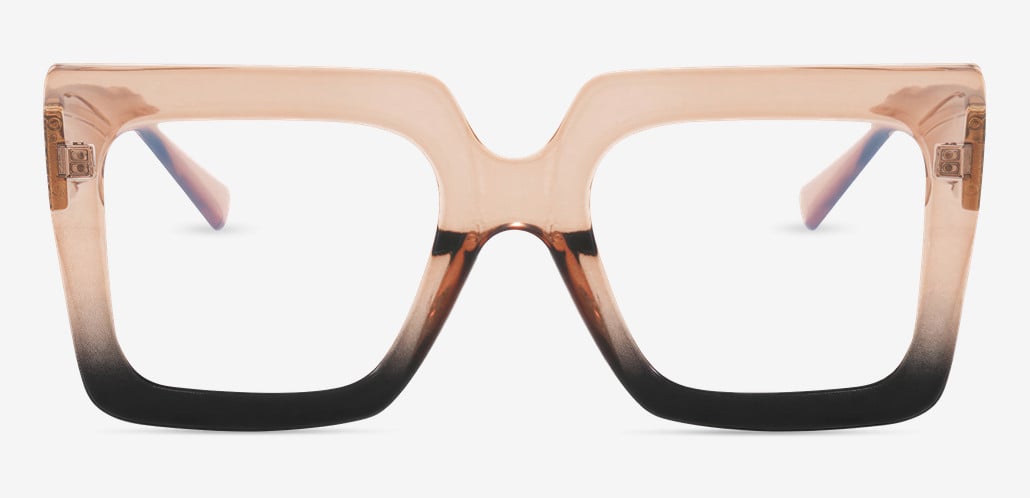

Hold the sunglasses in front of a lit LCD screen, such as a laptop, an ATM or a gas pump display, and slowly turn them through a half circle. If the screen goes dark at one point and brightens again as you keep turning, the lenses are polarized. If nothing changes, either the lenses aren't polarized or the screen isn't a good test object. That second possibility is where most at-home checks go wrong, and it's what the rest of this guide is about.
Every polarization test borrows someone else's light
You can't see polarization by staring at a lens. Under a lamp or in plain sunlight, a polarized lens looks exactly like a tinted one, because that light is unpolarized: it vibrates in every direction at once, and the filter simply dims it.
The filter only shows itself when the light hitting it is already polarized. Then the lens behaves like a gate. Line it up with the light and it passes; turn it 90 degrees and it blocks. Polarized sunglasses are built to block horizontally polarized light, which is what bright glare off a flat road or a lake mostly is (American Academy of Ophthalmology).
So every test you've read about is really two things: your lens, plus a source of polarized light you're borrowing. If the source is weak or unusual, a perfectly good pair can "fail." Here's how the common sources compare.
| Light source | How reliable | What a polarized lens does | How it can fool you |
|---|---|---|---|
| Laptop or desktop LCD monitor | High | Screen goes near-black at one angle, then returns | Some monitors are polarized on a slant, so the dark point lands at a diagonal. That's normal. |
| Gas pump, ATM or self-checkout LCD | High | Display blanks out at one angle | Rarely misleads; just make sure it's an LCD, not a printed sign. |
| Phone or tablet | Mixed | Dims in portrait, in landscape, or barely at all | The polarization angle varies by brand, model and even replacement screen. A thick screen protector weakens the effect. |
| Clear blue sky about 90° from the sun | Good on clear days | A patch of sky darkens and lightens as you turn | Never goes fully black. Little effect near the sun, opposite it, or under haze and cloud. |
| Glare off water, a wet road, a glossy floor or painted car hood | High at the right angle | Glare drops sharply | Weak when you look straight down. Mirrors, chrome and metal reflections barely change. |
| A pair you know is polarized | High, if the reference is real | Overlapping lenses go dark when crossed at 90° | Only as trustworthy as the "known" pair. |
| Polarized test card at a store counter | High | A hidden image appears | A photo of a test card on your screen won't work. |
Two rows deserve a closer look.
Reflections have a sweet spot. Light bouncing off water is most strongly polarized at about 53 degrees from straight down, a figure known as Brewster's angle (overview). Polished floors and glass sit close to that. For an adult standing with eyes around 5 feet 3 inches off the ground, that puts the best test patch roughly 7 to 8 feet in front of your feet. Look at a puddle or a shiny floor that far ahead, not the one under your shoes. Avoid mirrors and chrome: reflections off metal stay mostly unpolarized, so even excellent lenses won't change them much.
The sky only goes so dark. Skylight is most polarized in a band about 90 degrees from the sun, and even there it typically tops out near 80 percent (Rayleigh sky model). Researchers at Montana State University note that rocking polarized sunglasses against that band makes the sky alternate between bright and dark but never black (SPIE, Optics in the Air). To find the band, point at the sun and make an L with your thumb and index finger. Wherever your thumb sweeps as you rotate your wrist is roughly where the effect is strongest. Use the sky to answer "polarized or not," never "how good."
One more trap: online "polarization test images." A test card works because different areas of its film point in different directions. Your screen sends out the whole picture with a single polarization, so a photo of that card has nothing hidden left to reveal.
The half-turn rule: why "flip the phone" gives wrong answers
Most people run the phone test by turning the phone from portrait to landscape. That checks only two positions, 90 degrees apart, and it works only if the screen happens to be polarized straight up-and-down or side-to-side.
Many screens aren't. Phone makers set the polarization angle differently, which is why one phone blacks out in portrait and another in landscape (Honor support). If a screen's light is polarized on a diagonal, near 45 degrees, a polarized lens passes about half the light in both positions. Portrait and landscape look equally dimmed, and the test seems to say "not polarized."
The fix: keep the screen still and turn the glasses, slowly, through a full half circle. Think of a steering wheel going from 9 o'clock all the way around the top to 3 o'clock. If the screen sends out polarized light, a polarized lens will hit one clear darkest point somewhere in that half turn. Flipping between two positions can skip right past it.
If a full half turn still changes nothing on your phone, don't blame the glasses yet:
- Take off a thick screen protector or try another device. Honor's support team notes thicker protectors, around 0.2 mm, reduce the effect.
- Switch to a laptop or a gas pump. Some screens are designed not to cooperate. Apple, for one, has explored displays that send out circularly polarized light specifically so polarized sunglasses don't black them out (AppleInsider). A screen like that won't change at any angle.
- Call it only after two different sources agree. One LCD plus the sky, or one LCD plus a glossy reflection. Two "no change" results from two kinds of source means the lens isn't polarized.
Past "yes": three more things the same test tells you
Once you've found the dark point on a laptop screen, keep the glasses there. In about 30 more seconds, the same setup answers questions most guides skip.
-
Do both lenses go dark together?
Close your left eye, then your right. Each lens should hit its darkest at the same rotation. If one blacks out clearly before the other, its filter is sitting rotated in the frame. The international sunglasses standard, ISO 12312-1, allows the filters to tilt no more than 5 degrees from vertical and the two sides to differ by no more than 6 degrees (ISO 12312-1:2022). A few degrees is invisible at home. A mismatch you can plainly see is bigger than that, and worth raising with the seller.
-
How dark does it get?
On an LCD, a strong polarizer takes the screen close to black. A weak one leaves a dim gray. ISO 12312-1 requires polarizing efficiency above 78% for filter categories 2 to 4, above 60% for category 1, and notes that category 0 lenses have no useful polarizing effect. You can't measure a percentage at home, but "inky black" versus "still readable" is a fair rough split. Judge this on a screen only; the sky never goes black, even through the best lens.
-
Is the darkening even, and where does the pattern live?
If you see blotches, keep your head still and slide the glasses sideways. If the blotches travel with the glasses, they're in the lens, usually an unevenly applied film. If they stay put on the window or screen, they belong to what you're looking at. That distinction saves a lot of pairs from being blamed for something they didn't do.
No screen handy? Signs you've probably already seen
If you've worn the pair outdoors, it may have answered the question already.
- Spotted car windows. Polarized lenses reveal a pattern of dark spots or a faint grid on the rear and side windows of cars parked in the sun. These are quench marks, a normal by-product of tempering glass. Service bulletins from GM and Toyota tell dealers not to replace windows over them and note that polarized sunglasses make them more visible (Toyota tech tip via NHTSA; GM bulletin via Jalopnik). GM's note adds you won't see them on windshields, which are laminated, so check the back glass.
- A blank pump or ATM screen that came back when you tilted your head.
- Some car head-up displays that fade or disappear while you're wearing the pair.
- Seeing into water. Rocks, weeds or fish under the surface of a pond or creek that vanish behind glare when you lift the glasses.
Any one of these, confirmed by lifting the glasses on and off, is a strong sign. None of them tells you whether both lenses are aligned, so still do the eye-by-eye check above if you can.
Prescription polarized sunglasses: one extra check when they arrive
With a prescription pair, the lab orients two things in every lens: the axis of your astigmatism correction and the axis of the polarizing film. The international standard for prescription lenses mounted in frames, ISO 21987, includes a separate orientation requirement for polarizing lenses for this reason (ISO 21987 preview).
Run the both-eyes check from the previous section on delivery day, and keep it in mind later. If a lens works loose and starts to turn in its rim, both axes turn with it. A lens that suddenly darkens at a different angle from its partner can be the first visible sign, sometimes before your vision feels slightly off. Either way, have the fit checked rather than tightening it yourself.
What the label can and can't tell you
Labels are claims. The test is the proof. Still, some wording is more useful than others.
- "100% UV protection" or "UV400" says nothing about polarization. They're separate features, and the AAO notes a UV label doesn't mean a lens is polarized.
- "Polarized" etched into the lens, or a small mark near the logo, is a more durable claim than a peel-off sticker. Test it anyway.
- "Anti-glare" is ambiguous. Some sources use it to mean polarized, but in US optical shops it usually means an anti-reflective coating, which is a different thing (more in our guide to what anti-glare glasses actually fix). If a sunglass listing says only "anti-glare," ask which one.
- "HD," "glare-reducing tint" or "polarized-style" have no agreed meaning. Treat the pair as unpolarized until it passes.
- Filter category 0 (nearly clear lenses) can't deliver a meaningful polarizing effect under ISO 12312-1, so a "polarized" clear fashion lens deserves extra skepticism.
If your pair fails, or you're still not sure
- Retest with two different kinds of source before deciding: an LCD plus the sky, or an LCD plus a glossy reflection about 7 feet ahead.
- Separate "not polarized" from "not protective." A non-polarized lens with a genuine 100% UV rating still blocks UV. It just won't cut reflected glare. Whether that matters depends on how much time you spend driving into low sun, on the water or on snow.
- If the listing promised polarized, record a 10-second phone video of the half-turn test against a laptop screen. It's clear, simple evidence for a return or exchange inside the seller's window.
- If an older pair used to pass and now doesn't, the film itself doesn't "run out." More often a lens was replaced, or heat or impact damaged the lens layers. Check whether both lenses still behave the same.
If you'd rather start with a pair that's sold as polarized and then check it yourself, browse Aoolia's polarized sunglasses, available with prescription lenses and virtual try-on. Run the half-turn test the day they arrive. It takes less time than reading this paragraph.
Shop polarized sunglassesFAQ
Why does my phone look normal through my polarized sunglasses?
Your screen may be polarized on a diagonal, use a circularly polarized design, or sit under a thick screen protector. Turn the glasses a full half circle in front of a laptop instead.
Can an online polarization test image tell me if my sunglasses are polarized?
No. A real test card relies on film pointing in different directions. A picture of it on your screen is polarized all one way, so nothing hidden appears.
Can sunglasses be polarized on only one lens?
It happens, usually after a single replacement lens or a mixed-up repair. Test each eye separately: cover one lens, then the other.
Are mirrored sunglasses polarized?
Not automatically. A mirror finish is a coating on the front, and polarization is a separate filter. Mirrored lenses can be both, but only the test tells you.
Why do car windows look spotted when I wear polarized sunglasses?
Those are quench marks from the tempering process in side and rear glass. They're normal, and seeing them is actually a good sign your lenses are polarized.
Sources
- American Academy of Ophthalmology, What Are Polarized Lenses For?, reviewed by J. Kevin McKinney, MD, June 2024
- ISO, ISO 12312-1:2022 Sunglasses and related eyewear, sample pages
- ISO, ISO 21987:2017 Mounted spectacle lenses, preview
- Honor, Phone screen appears dim or black with polarized sunglasses
- Shaw, Montana State University, Colors from Polarization, Optics in the Air (SPIE)
- Toyota Motor Sales, Tech Tip S-TT-0075-13: Spots in Window Glass (NHTSA)
- Jalopnik, Here's Why Your Rear Car Window Has Weird Spots
- Brewster's angle and Rayleigh sky model, Wikipedia
This article is general information and isn't a substitute for advice from a licensed eye care professional.