
Gold Aviator Sunglasses: What the Gold Actually Is, and How to Pick Your Finish
The "gold" on a pair of gold aviator sunglasses can mean very different things. It can be a hard, gold-colored coating with no gold in it at all, or a real layer of karat gold measured in millionths of an inch. Two numbers, 0.175 microns and 2.5 microns, decide which of those labels a seller can honestly use in the US.
Once you know where those two lines sit, product listings get much easier to read, and you can put your money into the finish that fits how you'll actually wear your sunglasses.
Key takeaways
A listing that uses "gold" or "gold-tone" as a color is describing how the frame looks. A listing that says "gold plated" is describing what the frame is made of, and that kind of claim is covered by federal guidance. A credible plating claim names the karat. The cheapest kind of gold finish is not automatically the least durable. And the sheen you choose (polished, brushed or matte) will shape daily ownership more than the price tag does.
"Gold" on a listing is two different claims
When a shopper searches for gold aviator sunglasses, they usually mean a color: warm, yellow-toned metal around a teardrop lens. Sellers use the word the same way, and that's fair. The trouble starts when the listing goes further and says "gold plated," "18K," or "real gold." Those words stop describing color and start describing metal content.
In the US, metal-content claims fall under the Federal Trade Commission's Guides for the Jewelry, Precious Metals, and Pewter Industries (16 CFR Part 23). Most people assume these rules only apply to rings and necklaces. In fact, the guides explicitly extend to optical frames made from precious metals, precious metal alloys, and their imitations. They also apply at every level of the trade, retailers included. So when you see a gold claim on a pair of sunglasses, it is fair to hold it to the same standard you would hold a gold claim on a bracelet.

The Micron Ruler: five places gold can sit on your frame
A micron is one thousandth of a millimeter. A human hair is roughly 50 to 100 microns thick. Every gold finish on a metal sunglass frame sits somewhere on the ruler below, and the rung it sits on tells you what the label on the listing is allowed to say.
Illustration only; layer thicknesses are not drawn to scale.
| Rung | What's on the frame | Label you'll typically see | Real gold? |
|---|---|---|---|
| 1. Gold-colored coating | A hard coating applied by ion plating or PVD (often titanium nitride, which is naturally gold-colored), or a lacquer or paint | "Gold," "gold-tone," "IP gold" | No |
| 2. Thin gold flash | Karat gold thinner than 0.175 microns | Often just "gold plated," with no karat mark | Yes, but very little |
| 3. Gold electroplate | Karat gold (10K or higher), at least 0.175 microns thick | "12K Gold Electroplate," "12K G.E.P.," "18K gold plated" | Yes |
| 4. Heavy gold electroplate | Karat gold (10K or higher), at least 2.5 microns thick | "Heavy Gold Electroplate" | Yes, a durable layer |
| 5. Solid karat gold | The frame itself is a gold alloy | "14K," "18K" (no "plated") | Yes, throughout |
Where the two lines come from
The first line sits at rung 3. Under the FTC's guides, an electroplating of gold or of a gold alloy of at least 10 karat, with a minimum thickness of 0.175 microns (about 7 millionths of an inch) of fine gold, may be described as gold plated or gold electroplated. That is hundreds of times thinner than a hair, and it still counts as plated.
The second line sits at rung 4: plating that meets the same fineness at a minimum thickness of 2.5 microns (about 100 millionths of an inch) may be called "Heavy Gold Electroplate." That is roughly 14 times more gold than the rung 3 minimum.
Rung 2 is the gray zone, and it changed recently. Older versions of the guides allowed plating that met the minimum fineness but not the minimum thickness to be called "Gold Flashed" or "Gold Washed." The 2018 revision no longer advises marketers that those terms are non-deceptive for plating thinner than 0.175 microns. In practice, you will rarely see "gold flashed" on a listing today. Very thin plating tends to show up simply as "gold plated," with no karat and no thickness.

The one detail that tells you which rung you're on
Look for a karat mark next to the word "plated." The guides describe a credible plating label as one where the term is immediately preceded by the karat fineness of the plating, shown just as conspicuously, for example "12 Karat Gold Electroplate" or "12K G.E.P." That gives you a simple reading rule:
18K gold plated places the frame on rung 3 or higher.
Gold plated with no karat anywhere can't be placed on the ruler at all. Treat it as rung 2 until the seller tells you otherwise.
Gold-tone or IP gold puts you on rung 1. That's a statement about color. Nothing is being hidden; it just isn't a gold claim.
One more detail helps when you compare labels: karat affects how the thickness is counted. One micron of 12-karat gold is treated as equivalent to half a micron of 24-karat gold. A thick layer of a lower karat and a thinner layer of a higher karat can therefore land on the same rung.
Why the lowest rung isn't automatically the worst
It is tempting to read the ruler as a quality ladder, with more gold always better. For looks and prestige, that's roughly true. For daily wear, it isn't. Gold is a soft metal. A thin layer on rung 2 or rung 3 can wear through at the hinges and temple tips faster than a hard titanium-nitride coating on rung 1, which is ceramic-like and much more scratch resistant. If your gold aviators are headed for car cupholders, beach bags and daily commutes, a well-applied gold-colored coating can be the more practical choice than a thin real-gold plating.
The higher rungs earn their price in other ways: color depth, the knowledge that the gold is real, and, at rung 4 and above, enough thickness to survive years of handling. Solid karat frames on rung 5 usually sell for four figures and up, and you are paying for the precious metal itself.
Where Aoolia's gold aviators sit
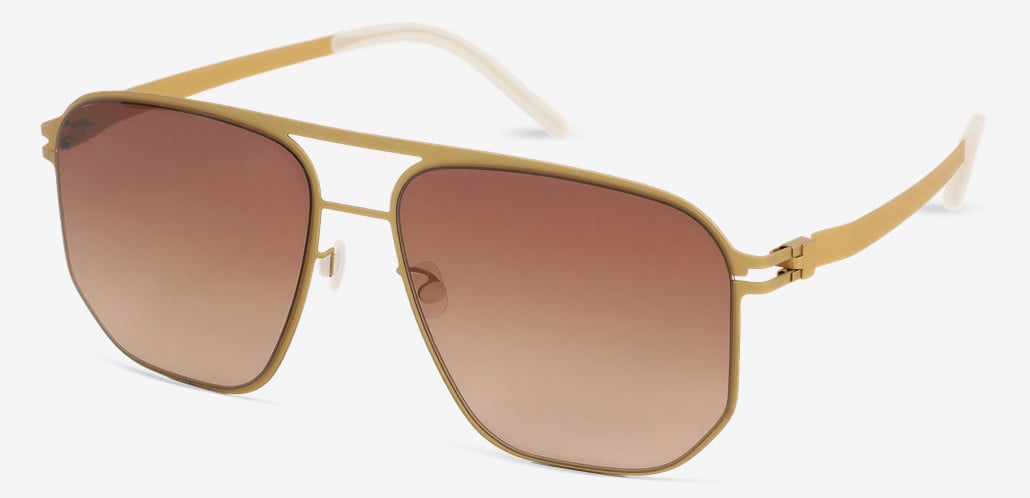
Aoolia's gold aviator sunglasses use gold-tone finishes over Sylvia Gold Aviator Sunglasses. On the ruler, that puts them on rung 1. We describe them as gold-tone, not gold plated, because that is what they are. Each product page lists the frame material, so you can compare pairs on facts rather than adjectives.
The Hue & Sheen Grid: choosing a gold you'll still like in a year
Once you know what the gold is, the next choice is how it looks. Two independent settings decide that: hue (which gold) and sheen (how the surface catches light). Most buying guides only talk about hue. Sheen shapes more of the day-to-day experience of owning the pair.
Sheen: pick it by how you handle your sunglasses
| Sheen | Fingerprints | Fine scratches | In photos | Reads as |
|---|---|---|---|---|
| Mirror-polished | Shows them most | Very visible, because each line breaks the reflection | Can flash bright hot spots under a camera flash or direct sun | Dressy, jewelry-like |
| Brushed / satin | Less visible | Scratches that run with the grain tend to blend in | Even, soft highlights | Refined but relaxed |
| Matte | Least visible | Hides them well at first, but spots you touch repeatedly can slowly polish to a shine | Flat, no glare | Casual, understated |
The practical question is how often you touch the frame and wipe it clean. If you push your sunglasses up onto your head ten times a day and rarely clean them, brushed is the most forgiving choice. If you mostly wear them to events and keep them in a case, polished pays off, because that's where its shine gets seen. If you want the gold to sit back and let the aviator shape do the talking, go matte, and expect the high-contact spots to develop a soft shine over time.
Hue: pick it by the metal already in your look
| Hue | What it looks like | Pairs most easily with |
|---|---|---|
| Pale / champagne gold | Low saturation, close to silver | Mixed metals; it's the most forgiving gold if you also wear silver or steel |
| Classic yellow gold | The saturated, traditional gold | Yellow-gold watches, jewelry and hardware |
| Rose gold | Warm, pinkish copper cast | Rose gold or copper accessories, blush and neutral palettes |
| Antique / dark gold | Deeper, slightly brown, sometimes shaded | Vintage-leaning outfits, leather goods and brass hardware |
Skip the skin-undertone quizzes here. Look instead at the metal you already wear every day: your watch case, belt buckle, bag hardware and earrings. The gold aviator that matches those will look intentional. The one that fights them will look borrowed.
Using the grid in two steps
First, choose sheen from your habits. Then choose hue from your hardware. A buyer who handles their sunglasses constantly and wears a steel watch ends up at brushed champagne gold. A buyer who saves sunglasses for weekends and wears yellow-gold jewelry ends up at polished classic gold. Neither is more correct than the other. Each simply matches its owner.
If you only remember one thing
Read the gold claim before you read the price. "Gold-tone" means color. "18K gold plated" means at least 0.175 microns of real karat gold. "Heavy Gold Electroplate" means at least 2.5 microns. Plain "gold plated," with no karat, can't be placed on the ruler until the seller answers. After that, let your habits pick the sheen and your jewelry pick the hue.
Ready to compare? Browse our gold aviator sunglasses, size up with oversized aviator sunglasses, or see aviator sunglasses for women. Virtual Try-On on each product page lets you check the gold hue against your face before you order.
Frequently asked questions
Are gold aviator sunglasses made of real gold?
Most fashion gold aviators get their color from a gold-tone coating, not from karat gold. Real gold appears either as plating, which should carry a karat mark such as "18K gold plated," or as a solid karat frame at luxury prices.
What does "18K gold plated" mean on sunglasses?
It means the plating is 18-karat gold. Under FTC guidance, the gold-plated label corresponds to a layer at least 0.175 microns thick. It does not mean the frame itself is 18K gold.
Is IP gold better than gold plated?
It depends on what "better" means to you. An ion-plated gold-colored coating contains no gold, but it is usually harder and more scratch resistant than thin gold plating. Gold plating gives you real gold, and at 2.5 microns or more ("Heavy Gold Electroplate") it becomes a durable layer.
Do matte gold aviators scratch easily?
Matte finishes hide fine scratches and fingerprints better than polished ones. The trade-off is that areas you touch often can slowly polish to a shine.
Does the gold finish on aviator sunglasses wear off?
Any surface finish wears first where the frame touches skin or moves. Our gold aviator sunglasses collection maps those contact points and explains how to slow the wear.
Rose gold or classic gold aviators: which is more versatile?
Neither is universally more versatile. Match the hue to the metal you already wear most. If you wear both silver and gold, pale champagne gold bridges them best.
Sources
Federal Trade Commission, Guides for the Jewelry, Precious Metals, and Pewter Industries, 16 CFR Part 23 (eCFR).
Federal Register, final revised Jewelry Guides, effective August 16, 2018.