
Fit & Appearance Guide
Bayonetta Glasses for Women: Will They Make Your Eyes Look Bigger or Smaller?
A slim frame puts a fine line of rim right above and below your eyes. Here's what that line does to how big your eyes look, how your lens power shifts it, and how to work out your own result before you order.
Slim frames look striking in product photos. Before checkout, though, most people have a more personal question: what will these do to my eyes? That's a fair worry. Narrow glasses sit close to the eye, so the effect is easy to notice, and it can work for you or against you.
When you shop bayonetta glasses for women, three things decide how big your eyes look behind the lenses: how close the rim sits to your eye, how strong your lenses are, and how heavy the rim line is. This guide goes through each one, gives you numbers you can check against your own lenses, and shows where a slim frame helps and where it can't.
Key takeaways
- Close rims can make eyes look larger. In perception research, a shape surrounded by a close outline tends to look bigger (the Delboeuf illusion). A 2015 face study found the same thing with eyebrows: when they sat closer to the eyes, the eyes looked larger.
- Your lenses add a separate shift. Lenses for nearsightedness (minus numbers) make eyes look smaller to other people, and plus lenses make them look larger. A simple thin-lens estimate puts this at about 1.5% per diopter.
- Rim weight sets the strength of the outline. A darker, thicker rim frames the eye more firmly, and it also hides the thicker lens edges that strong minus lenses have.
- Try On shows only the frame. It can't show what your lens power will do, so you add that part yourself.
First, What Makes Glasses "Bayonetta"?
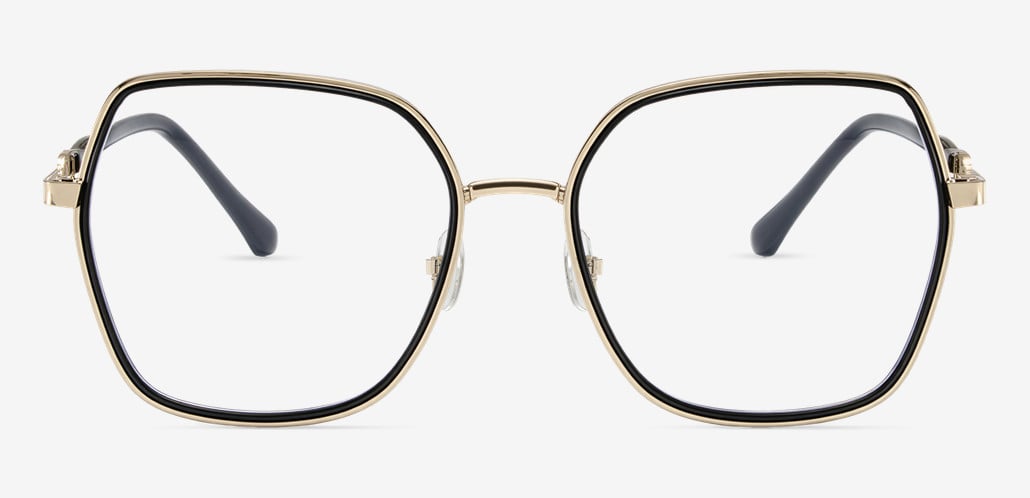
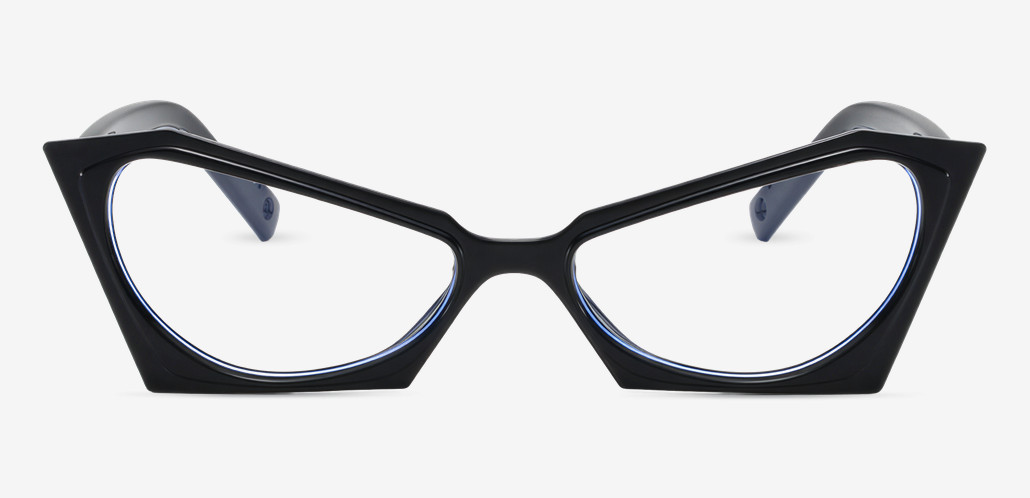
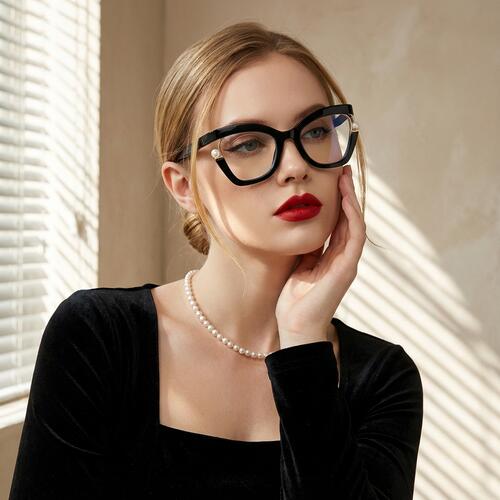
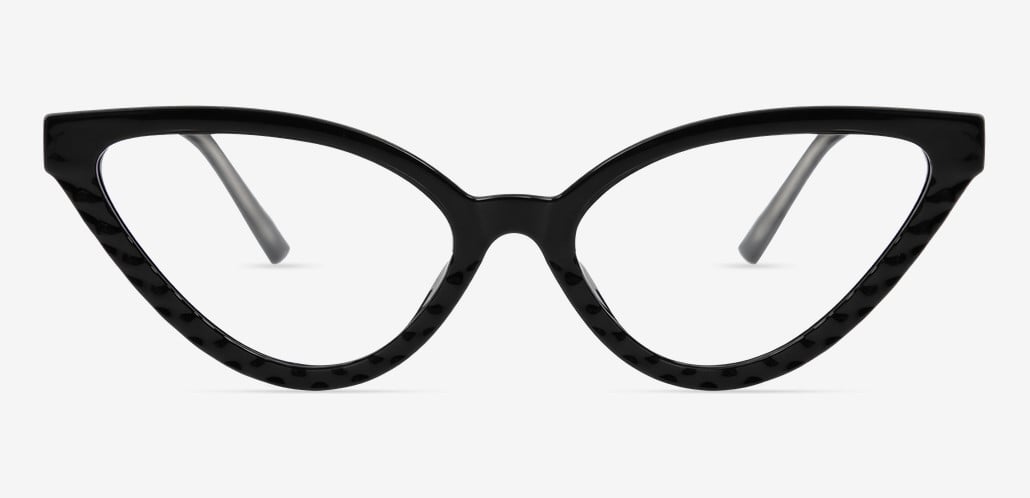
"Bayonetta glasses" is a fashion nickname for slim, narrow-lens frames. Most bayonetta glasses for women are rectangles, slightly lifted cat-eyes, or narrow ovals. The name refers to a style, not a brand. What matters for this guide is one physical fact: with the lens so short from top to bottom, the upper and lower rims sit much closer to your eye than they would on a standard or oversized frame. Everything below follows from that.

The Eye-Size Equation
People see your eye through a lens and inside a frame. Their impression of its size comes from a few separate effects added together:
How big your eyes look
=
Natural eye size
+
Frame Pull
±
Lens Shift
×
Line Weight
You can't change your natural eye size, but you can change each of the other three. Here's how each one works.
Term 1
Frame Pull: how close the rim sits
The Belgian scientist Franz Joseph Delboeuf described a well-known size illusion in 1865. A circle drawn inside a slightly larger circle looks bigger than the same circle on its own. Put it inside a much larger circle and it can look smaller. When the outline is close, the eye tends to merge the two shapes and read the inner one as larger. When the outline is far away, the gap makes the inner shape look smaller by contrast.
In 2015, researchers at Osaka University (Morikawa, Matsushita, Tomita and Yamanami, Frontiers in Human Neuroscience) tested whether this happens on real faces. They moved eyebrows higher or lower on face photos. Eyes looked larger when the brows sat closer to them, and the team concluded that the effect works the same way as the Delboeuf illusion. A 2019 follow-up from the same lab found the related eyeshadow effect held when the face was turned, not only when it faced straight on.
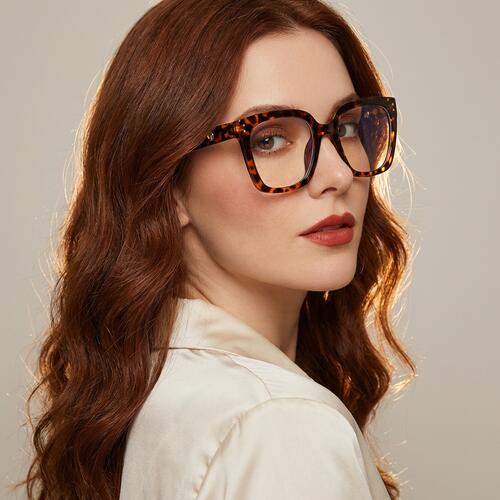
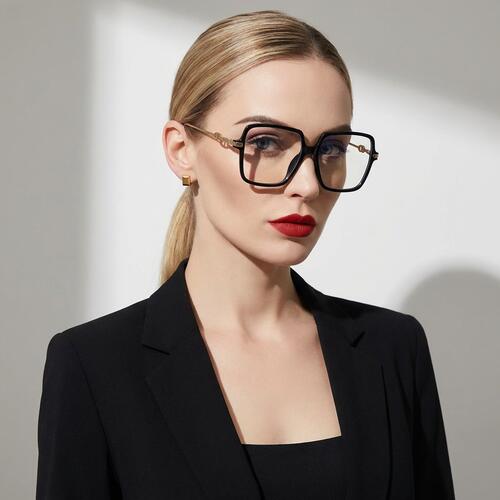
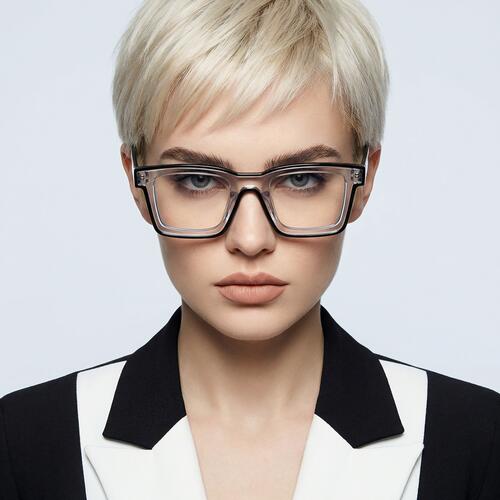
What this means for slim frames: the top rim of Bayonetta glasses sits in roughly the same place as a low brow line, and the bottom rim adds a second close outline below. That close outline is the setup the research ties to larger-looking eyes. A tall, oversized frame does the opposite: its rims sit far from the eye, which matches the common experience that very big glasses can make eyes look smaller.
slim rim
Close outline
Rims near the eye. The eye tends to read larger and more defined.
standard rim
Medium gap
A small effect either way. The eye reads close to natural.
oversized rim
Wide gap
Lots of space around the eye. The eye can read smaller by contrast.
An honest caveat: the 2015 study tested eyebrows and eyeshadow, not glasses, and the effects it measured were modest. We're applying the same mechanism to frame rims, which is a reasonable extension but not a measured result. Think of Frame Pull as a nudge, not a transformation.
Term 2
Lens Shift: what your lens power does
This term is plain optics, not illusion. When someone looks at your eye through your lens, the lens changes how big your eye looks to them. Minus lenses (for nearsightedness) make eyes look smaller, and plus lenses (for farsightedness and readers) make them look larger. A simple thin-lens estimate looks like this:
Apparent eye size ≈ 1 ÷ (1 − 0.015 × lens power)
The 0.015 is an assumed distance of about 15 mm from the back of the lens to the visible part of your eye, a typical value for glasses that sit normally on the nose. Use the SPH number from your prescription for each eye:
−1.00
≈1.5% smaller
−2.00
≈3% smaller
−4.00
≈6% smaller
−6.00
≈8% smaller
−8.00
≈11% smaller
+1.00
≈1.5% larger
+2.00
≈3% larger
+4.00
≈6% larger
Rounded estimates. Real lenses vary with thickness, curve and how close the frame sits. If you have a CYL number, your eye may also look slightly narrower or wider in one direction, because the power differs by direction.
Two practical points come out of the formula. First, the shift grows with power: it's hard to see at −1.00 and easy to see at −6.00. Second, the distance in the formula matters. A frame that sits a little closer to your face makes the shift slightly smaller, and adjustable nose pads let you fine-tune that, as long as your lashes still clear the lens.
Term 3
Line Weight: how strong the outline is
Frame Pull depends on the rim being visible as an outline. A barely-there rim gives a faint outline, and a bold one gives a strong outline. The Osaka study also found that eyeshadow's soft dark shading made eyes look larger, and that this shading effect was stronger when the face was seen from farther away. Our reading is that a dark rim close to the eye works in a similar direction, but that's an inference, not a tested fact.
Thin metal or clear
A light outline. Your eyes look close to how they look without glasses, so whatever your lenses do shows more plainly.
Slim acetate or TR90
A clear but soft outline. It's the everyday middle ground and gives a noticeable Frame Pull without looking heavy.
Bold dark acetate
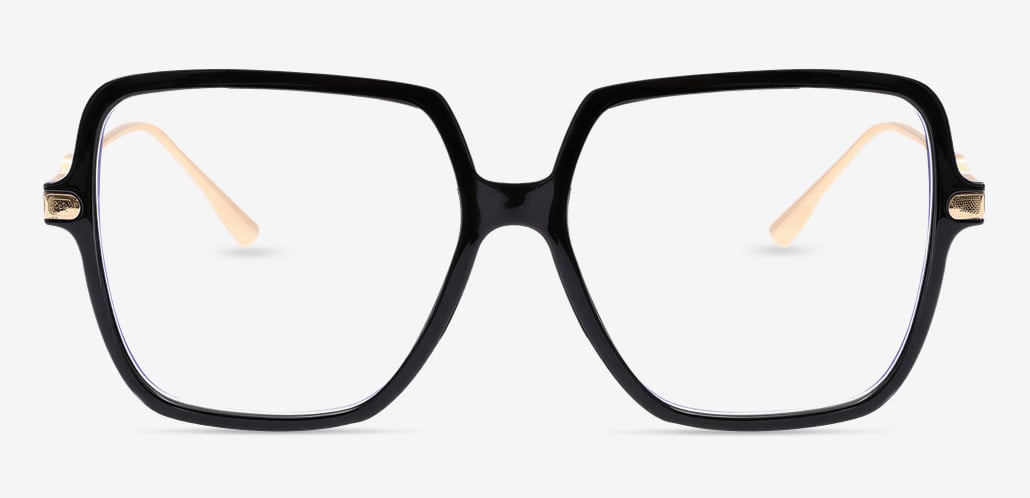
The strongest outline and the most "drawn-on" Bayonetta look. It's also the best at hiding thick lens edges.
That last point matters for anyone with a stronger minus prescription. Minus lenses are thicker at the edge, and a solid, darker rim hides that edge where a thin metal rim would leave it visible.
Put Your Numbers In: Five Worked Examples
Here's how the three terms combine for common lens situations. Find the one closest to yours.
0.00
No lens shift
Fashion pair or clear lenses
Only Frame Pull and Line Weight apply, so this is the most eye-forward way to wear a slim frame. Pick the line weight for how defined you want the look: thin metal for barely there, bold acetate for a strong outline.
−1.50
≈2% smaller
Mild nearsightedness
A shift this small is rarely noticeable on its own, so the frame does most of the work. Any line weight suits you. Choose the color and outline you like, and the close rim keeps your eyes looking defined.
−6.00
≈8% smaller
Strong nearsightedness
Here the lens is the biggest term, and people will notice it in any frame. A slim frame still helps in two ways. A smaller lens means less thick edge to see, and the close rim adds a little Frame Pull in your favor. Lean toward slim acetate or bold dark rims that hide the edge, and use adjustable nose pads to sit the frame a touch closer. Thinner high-index lenses make the lens slimmer, but they don't remove the size shift.
+2.00
≈3% larger
Readers
Plus lenses slightly enlarge your eyes, and only while you're wearing them. A slim reader keeps the magnified area small, so the effect looks tidy rather than bug-eyed. Plus lenses are thickest in the center, and a smaller lens also keeps that center thinner.
R −1.00
L −4.50
≈1.5% vs ≈6%
One eye much stronger than the other
The two lens shifts differ by about five points, so one eye can look smaller than the other. A slim frame keeps both lenses small, and a solid rim helps hide the mismatch in edge thickness. If the difference bothers you, ask your eye doctor about your options. A frame can soften it but can't even it out.
Once you know which situation is yours, you can shop by line weight with confidence. Our bayonetta glasses for women collection lets you filter by material, which is the quickest way to narrow your outline: metal and titanium for thin, TR90 and slim acetate for medium, fuller acetate for bold.
What a Slim Frame Can't Change
Being clear about the limits is as useful as the tips.
It can't cancel a strong lens.
At −6.00 and beyond, the lens shift is large enough that a frame illusion won't undo it. A slim frame makes the result look neater. It doesn't make it disappear.
It can't fix uneven prescriptions.
If your two eyes need very different lenses, they'll look slightly different sizes in any glasses. Frame choice can soften the difference, but it can't even it out.
It can't help if the rim covers your eye.
Frame Pull only works when the rim frames the eye. If the top or bottom rim cuts across your eye, the frame crowds it instead. On very narrow styles, check that both rims sit clear of the eye itself.
How to Check Before You Order
-
Find your SPH numbers.
Read the SPH value for each eye on your prescription and match it to the nearest tile above. That's your Lens Shift.
-
Preview the frame with Try On.
Take a straight-on screenshot and look at the rim, not the style. Both rims should frame your eye, close but not covering it.
-
Add your lens shift yourself.
Try On previews the frame. It can't show your lens power. If your number is strong, picture your eyes a little smaller (minus) or larger (plus) than the screenshot shows.
-
Choose your line weight.
For strong minus, choose slim acetate or bold rims to hide the edge. For mild or no power, any weight works, so pick for the look.
-
Confirm the size.
Compare the frame, lens, bridge and temple measurements on the product page with a pair that already fits you well.
Bayonetta Glasses and Eye Size: FAQ
Do Bayonetta glasses make your eyes look smaller?
The frame itself usually doesn't. The rims sit close to your eye, which is the setup perception research links to eyes looking larger, not smaller. If your eyes look smaller in glasses, the usual cause is minus lens power, and that happens in any frame.
Are Bayonetta glasses good for a strong prescription?
Often, yes. A small lens has less thick edge to show with minus lenses and a thinner center with plus lenses. Pair a strong minus prescription with a solid acetate rim to hide the edge, and check on the product page which lens options each frame offers.
Can I wear Bayonetta glasses if one eye is much stronger than the other?
Yes. Keeping both lenses small and choosing a solid rim helps hide the difference in edge thickness. The size difference between your eyes comes from the lenses, though, so talk it over with your eye doctor if it bothers you.
Will Virtual Try-On show how my eyes will look?
Try On shows how the frame sits and how close the rims are to your eyes. It doesn't show the effect of your lens power, so for strong numbers, add the Lens Shift from the tiles above in your head.
Black or clear Bayonetta frames: which makes eyes stand out more?
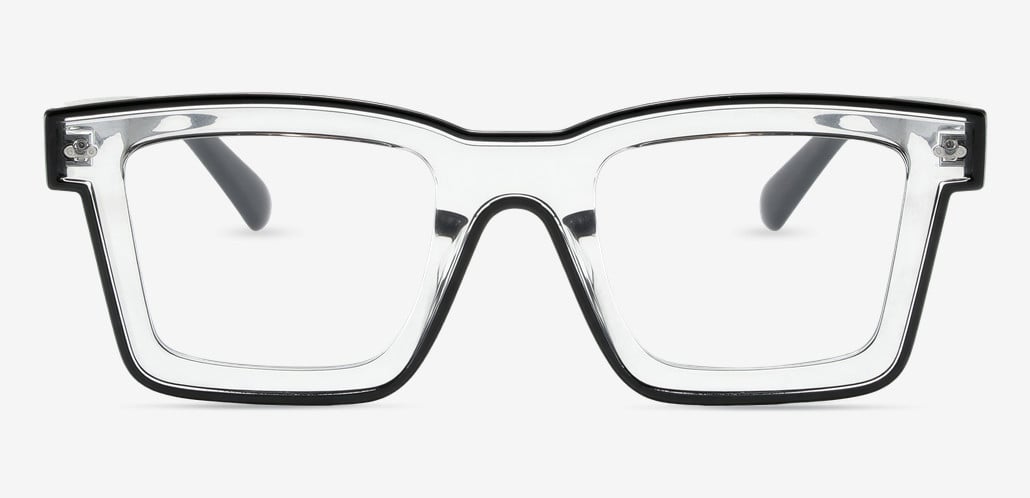
A darker rim makes a stronger outline, so it frames the eyes more firmly. A clear or thin metal rim keeps the look softer and closer to your eyes without glasses. Both are good choices; they just give a different level of definition.
Do Bayonetta glasses work as readers?
Yes. Plus lenses slightly enlarge the eyes, and a slim frame keeps that magnified area small and neat, so the effect stays subtle.
Find your slim frame
Know your lens shift, pick your line weight, then preview the outline on your own face. Browse the full collection of slim frames:
bayonetta glasses for womenHow we put this guide together
This guide was written by the Aoolia Editorial Team. It explains frame style and appearance. It isn't medical advice, and questions about your vision or prescription are best answered by your eye doctor.
- Delboeuf illusion: first described by Franz Joseph Delboeuf in 1865.
- Morikawa K., Matsushita S., Tomita A., Yamanami H. (2015). "A real-life illusion of assimilation in the human face: eye size illusion caused by eyebrows and eye shadow." Frontiers in Human Neuroscience, 9:139.
- Muto H., Ide M., Tomita A., Morikawa K. (2019). "Viewpoint invariance of eye size illusion caused by eyeshadow." Frontiers in Psychology, 10:1510.
- Lens Shift figures: thin-lens estimate, 1 ÷ (1 − d × F), with d ≈ 0.015 m. These are rounded approximations, not lab measurements.