
Men's Eyewear Guide
Rimless Glasses for Men: The Edge, the Hardware, and the Sun Plan
Take the rim away and three small details decide how a pair looks and how it lives with you: the finish on the lens edge, the metal parts holding everything together, and what happens when the sun comes out.
Sit across a desk from a man in rimless glasses and the shape is rarely the first thing you notice. It's a thin line of light around each lens, where the bare edge catches the ceiling fixtures. If his prescription is on the stronger side, you may also see a few pale rings stacked just inside that line, like the grain at the end of a cut log.
Hardly anyone picks that line on purpose. Nobody really chooses the two small metal pieces at the outer corners either, even though they decide how wide the glasses look. And the clip-on sunglasses that keep sliding because there's no rim to hold onto tend to be a surprise too. Most shopping for rimless glasses for men starts and ends with "clean and minimal." This guide covers what comes after that: the details that decide whether the pair still looks clean and minimal once you're wearing it.
The short version
- The edge is your new frame line. A satin edge finish is the safe everyday choice. Bright polish looks crisp but throws more light around, and strong minus prescriptions need a plan for edge rings.
- The metal is the style. On a rimless pair the bridge, end pieces and temples are the entire design, and they set the fit too. A bit of arithmetic with the product-page sizes tells you how much width the end pieces add.
- Settle sun protection before checkout. Ordinary clip-ons are built to grip a rim. On rimless glasses they sit on bare lens, which is how lenses get scratched.
First, Make Sure You're Shopping the Right "Rimless"
Three different constructions are sold under the same word. They look different enough that it's worth knowing which one you're looking at in a product photo.
Three-piece (drill mount)
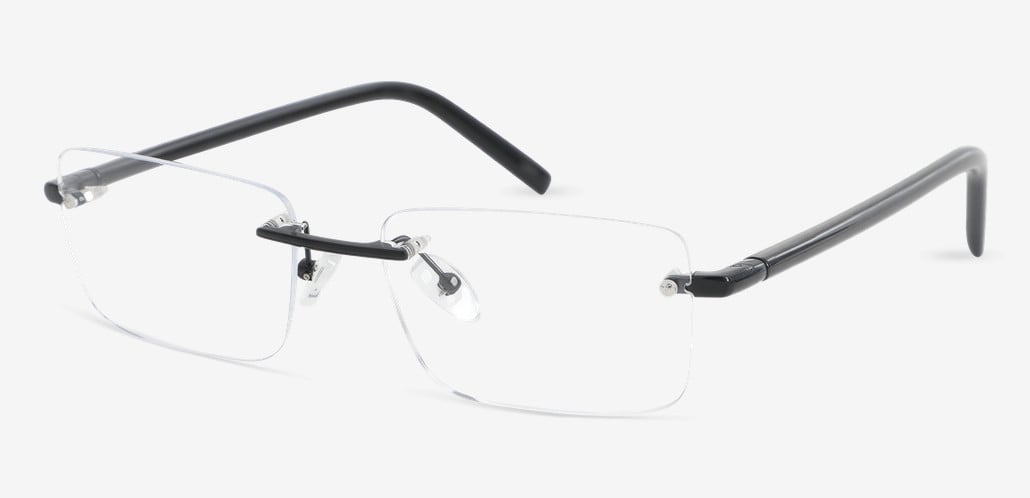
Each lens is drilled near the nose and near the temple, and the bridge and temples attach straight to those holes with screws or press-fit bushings. Nothing wraps the edge. This is rimless in the strict sense.
Rimways (Cortland style)
The lenses are still rimless, but a slim metal bar runs across the top and links the bridge to the temples, taking some of the load. You get a hint of a brow line without a full frame.
Semi-rimless
A rim along the top and a thin nylon cord under the lens. Online filters often file it under rimless, but only the lower edge of the lens is exposed.
Most of what follows applies to the first two, because those are the frames where the whole lens edge is on show.
1. The Edge Is Your New Frame Line
In a full-rim frame, the lens edge is ground to a V-shaped bevel and tucked into a groove where nobody sees it. In a drill-mount pair it's a flat band of lens material, exposed all the way around. Whatever finish the lab leaves on that band becomes the outline of your glasses, so it does the job a frame used to do.
Why strong minus lenses show rings
A minus lens, the kind used for nearsightedness, is thin in the middle and thick at the edge. Light gets in through that exposed edge, bounces around inside the lens, and some of it comes back out through the front. To someone looking at you, it shows up as a set of pale concentric rings near the edge. Opticians call them myopia rings. A thicker edge means more rings, so they increase with prescription strength, with lens size, and with lower-index lens materials.
Plus lenses, used for farsightedness and in readers, work the other way: they're thick in the center and thin at the edge, so rings rarely come up. That's one reason rimless readers are so common.

The Edge Finish Card
Labs finish exposed lens edges in a handful of ways. Here's how each one looks and behaves on rimless glasses for men, where the hardware is usually slim and the edge gets most of the attention.
Bright polish
- How it looks
- Glass-clear and crisp. Under overhead light, the outline flashes.
- Light & rings
- The most internal reflection of the four, so rings are most visible in minus lenses. Opticians who use it on stronger prescriptions tend to pair it with an anti-reflective coating.
- Suits
- Low prescriptions, readers, non-prescription pairs, polished gold or silver hardware.
Satin
- How it looks
- Smooth, with a soft sheen. The outline reads as a fine line instead of a glint.
- Light & rings
- Fewer internal reflections than bright polish. Many technicians who mount screw-in rimless lenses use it as their default for that reason.
- Suits
- An everyday pair, most minus prescriptions, almost any hardware.
Frosted (unpolished)
- How it looks
- A cloudy, pale line traces each lens like a pencil border. It doesn't flash, but you can see it.
- Light & rings
- No shine. The trade-off is the visible white outline itself.
- Suits
- Matte gunmetal or black hardware, and men who like the lens to look drawn on.
Tinted edge
- How it looks
- The edge band picks up a faint color matched to your skin tone.
- Light & rings
- Masks the white rings in strong minus lenses instead of trying to remove them.
- Suits
- High minus prescriptions. It's a specialty request, so ask before ordering rather than assuming it's offered.
Match the luster
Many opticians follow a simple rule: polished edges with glossy hardware, satin or unpolished edges with matte hardware. A shiny edge next to a brushed bridge stands out more, not less.
Preview your rings before you buy
Your current glasses can already show you how much ring you'll have to deal with. Stand under an overhead light, hold your phone at arm's length, and take a photo while looking just past the camera. Zoom in on the outer part of each lens. In a full-rim frame the rim hides part of the rings. In a rimless frame they run all the way around with nothing to break them up. If you can see a clear stack of rings in that photo, treat the edge plan below as a requirement, not a nice-to-have.
| Your prescription (stronger eye) | What the edge does | Edge plan |
|---|---|---|
| Non-prescription, readers, or any plus (+) | Thin edge; rings are rare | Any finish. Bright polish is fine if you like the crisp look. |
| Mild minus, about −0.25 to −2.00 | Faint rings, mostly in bright light | Satin or polish, with an anti-reflective coating |
| Moderate minus, about −2.25 to −4.00 | Rings show up in photos and on video calls | Satin; consider a higher-index lens and a moderate lens width |
| Strong minus, beyond −4.00 | Thick edge; rings visible from across a room | Satin or tinted edge, higher-index lens, smaller lens width; ask about the finish before ordering |
These bands are rough and describe how the edge looks, not whether rimless is right for you.
What you control when ordering online
You usually can't pick an edge finish from a dropdown. The lab's default applies unless you ask. What you can always control is the lens index (Aoolia's rimless frames offer high-index lenses for stronger prescriptions), an anti-reflective coating, and the lens size. Lens size is the one people forget, and it links straight to the hardware.
2. Read the Hardware: Three Metal Parts Do All the Work
Without the rim, a pair of rimless glasses comes down to two lenses, a bridge, two end pieces and two temples, plus a few screws or bushings. The metal parts do two jobs at once: they're the whole visual design, and they're the whole fit. Product photos usually show the front at a flattering angle. These are the parts worth looking at closely.
For reference, Aoolia's men's rimless line currently has 16 frames: 11 in titanium and 5 in other metals. All of them have adjustable nose pads, four have spring hinges, and prices ran from $21.95 to $103.95 when this was written. Most are rectangular, with a few squares and one geometric shape, and you can compare them side by side in the full set of rimless glasses for men.
Bridge: the gold arc between the lenses
End pieces: the gold tabs at the outer corners
Temples: the arms, seen from the side
The bridge
Sets where the lenses sit and how your nose reads.
Straight bar with pad armsThe modern default. The pads adjust independently, so the lenses can be raised, lowered, or moved closer to your eyes. Handy with a low nose bridge or long lashes.
Arched bridgeA higher curve between the lenses. Reads more formal and more traditional, and shows more of the top of your nose.
Pad-less bridgeRests directly on the nose. The cleanest look, but nothing adjusts, so it has to fit right out of the box.
The end pieces
Decide how wide the glasses look.
FlushThe temple starts right at the lens edge. The narrowest and least visible option.
ExtendedA short metal arm reaches past the lens before the temple starts. Adds width without bigger lenses.
WrappedThe metal hugs the outer corner of the lens. A small, visible accent, putting some structure back at the corners, which is where a full frame has its strongest lines.
The temples
Decide the side view and how the pair handles.
Round wireUsually titanium or beta-titanium. The lightest choice, and it almost disappears in profile.
Flat or bladeWider and easier to see from the side, so it feels more like a frame. Some men want exactly that.
Spring hingeLets the temple flex outward past its normal stop. Forgiving on a broad head and when you pull the glasses off one-handed.
The End-Piece Math: width without thicker edges
This is where the hardware and the edge come together. If you have a broad face and a minus prescription, the instinct is to size up the lenses. That gets you width, but every extra millimeter of lens adds edge thickness, and edge thickness is what makes rings. End-piece reach is the better way to get width.
You can estimate it from the lens width and bridge size (two of the three numbers printed on the inside of the temple) plus the total frame width, which many product pages list separately.
End-piece reach, per side
( Frame width − ( 2 × Lens width + Bridge ) ) ÷ 2
Example: lens 52 mm, bridge 18 mm, frame width 136 mm. 136 − (104 + 18) = 14, so about 7 mm of reach on each side. A frame with 56 mm lenses and only 2 mm of reach comes out almost as wide, but each lens is 4 mm larger across, and with a minus prescription the edges get noticeably thicker.
Two caveats. Not every product page lists frame width, and brands measure it slightly differently, so use the result to compare frames rather than as an exact spec. If the width isn't listed, compare a straight-on photo with a frame you already own and know fits.
Hardware color shows up as three dots
On a full frame, color is a solid outline. On rimless glasses it shows up in three small spots from the front (the bridge and the two corners), plus the temples from the side. So the choice matters less than a thumbnail suggests, and each color behaves a little differently:
BlackThree crisp dark points, the strongest contrast on most skin tones. The most graphic option.
GoldThree warm accents. Sits easily on warmer and deeper skin tones and looks a bit dressier.
Silver & gunmetalBlend in the most, and come closest to glasses that disappear. Gunmetal is the less shiny of the two.
Colored metalA blue or other tinted metal reads as a deliberate detail rather than a statement, simply because there's so little of it.
3. Settle Your Sun Plan Before You Order
This is the part of owning rimless glasses for men that catches people out a few weeks in. Clip-on sunglasses are the obvious answer for anyone who wears glasses all day, and most of them don't work well with rimless frames.
The problem is mechanical. A typical clip-on holds on with small hooks designed to grip the top and bottom of a rim. A rimless frame has no rim, so the hooks press directly on the lens surface or its exposed edge. They tend to slide, and a metal or hard-plastic hook pressing on a coated lens is a good way to scratch it. Clip-on makers say as much in their own fit guidance: they match rimmed clip-ons to metal frames and frameless clip-ons to thicker plastic ones, and they steer rimless wearers toward a custom-made clip-on or a separate pair of sunglasses.
Shape is the second problem. A rimless lens is cut to its own outline, and an off-the-shelf clip-on won't match it, so you end up with slivers of untinted lens at the corners.
| Option | How it works on rimless | The catch | Makes sense if |
|---|---|---|---|
| Standard clip-on | Hooks rest on bare lens | Slips; can scratch the coating; leaves gaps at the corners | You only need an emergency spare |
| Bridge-grip or custom-cut clip-on | Grips the bridge and is cut to your lens outline | Made for one exact pair; adds weight to a frame you chose for being light | You'll wear this one pair for everything |
| Fit-over sunglasses | Sit over your glasses without touching them | Bulky, and they look it | You want a spare in the car or on the boat |
| Photochromic (light-reactive) lenses | Your rimless lenses darken outdoors | They react to UV, and most windshields block much of it, so they darken little while you drive | You walk or commute on foot more than you drive |
| Separate prescription sunglasses | A dedicated sun pair | A second purchase and a second case to carry | You drive daily or spend long days outside |
If you drive most days, a separate sun pair is the only plan here with no compromise.
4. Three Orders, Worked Through
These are hypothetical customers, here to show how the edge, hardware and sun decisions fit together when you're actually ordering rimless glasses for men.
−4.75
The commuter
Office job, a 40-minute drive each way, broad face.
EdgeSatin, high-index lens, anti-reflective coating. If his ring-preview photo shows a clear stack, he asks about a tinted edge.
HardwareA moderate lens width with extended end pieces instead of oversized lenses; spring hinges for the broad head.
SunSeparate prescription sunglasses for the car. Photochromic lenses wouldn't do much behind his windshield.
+2.00
The reader
Needs help with menus, his phone and paperwork. Wants a pair that lives in a jacket pocket.
EdgeAnything goes, since plus lenses keep the edge thin. Bright polish looks sharp with polished gold hardware.
HardwareSmaller lenses, round wire temples, flush end pieces: the lightest, most pocketable build.
SunHe rarely reads outdoors, so a pair of tinted readers covers the odd patio menu.
−1.25
The weekend pair
Already owns a full-rim everyday pair. Wants something lighter for weekends, mostly on foot.
EdgeFrosted or satin, to match matte gunmetal hardware.
HardwareBlade temples, because he wants the glasses to show from the side; wrapped end pieces for a little structure.
SunPhotochromic lenses suit someone who's walking, not driving.
Questions Men Ask About Rimless Glasses
What's the difference between rimless and semi-rimless glasses for men?
Rimless glasses (three-piece or drill mount) have no rim at all: the bridge and temples attach directly to holes in the lenses. Semi-rimless glasses keep a rim along the top and hold the lens with a thin cord underneath. Since only the lower edge of a semi-rimless lens shows, the edge finish matters less, and clip-ons have a top rim to grip.
Can I get rimless glasses with a strong prescription?
Usually, yes, if you plan for it. Strong minus lenses have thick edges that show rings in a rimless frame, so choose a higher-index lens, a moderate lens size, an anti-reflective coating and a satin or tinted edge. Drill-mount frames also need impact-resistant lens materials such as polycarbonate or Trivex, because standard plastic can crack around the holes. With a high prescription, check the lens options on the specific frame before you order.
Do clip-on sunglasses work on rimless glasses?
Standard clip-ons are designed to grip a rim. On rimless glasses they sit on bare lens, they can slide, and they can scratch the coating. A clip-on that grips the bridge and is cut to your lens shape works better. If you drive every day, a separate pair of prescription sunglasses is simpler.
Why is there a bright line or rings around the edge of my rimless lenses?
The exposed edge reflects light. A bright polish shows up as a glinting outline, and in minus lenses, light bouncing around inside the thick edge appears as concentric rings. A satin edge finish, an anti-reflective coating and a thinner lens (higher index or smaller size) all cut it down.
Are rimless glasses a good choice for reading glasses?
Reading glasses are one of the best uses for rimless. Reading lenses are plus lenses, which are thin at the edge, so the outline stays clean and rings aren't a concern. The light weight also suits a pair you carry around in a pocket.
Can rimless glasses double as safety glasses at work?
No. Everyday rimless frames aren't safety eyewear. If your job requires eye protection, you need frames and lenses marked to the ANSI Z87.1 standard, which are a separate product.
Ready to compare frames?
Open the full lineup of rimless glasses for men, run each frame's lens and bridge sizes through the End-Piece Math above, and use virtual try-on to see how the hardware color looks on your own face before you decide.
How this guide was put together. Catalog details (frame count, materials, features and price range) come from Aoolia's men's rimless category page as of November 5, 2026, and may change. The guidance on edge finishes and myopia rings draws on published discussion among optical lab technicians and on patent literature describing lens-edge reflections. The clip-on guidance draws on clip-on makers' own fit advice.
This article is general shopping information, not eye-care advice. For questions about your prescription, talk to your eye care provider.