
Retro Sunglasses: How Long Will the Look Last, and What Should You Spend?
Every pair of retro sunglasses comes with two questions most shoppers never say out loud. How long will this look feel right? And what is a pair worth if it only feels right for a while?
A pair of small '90s ovals bought this fall and a pair of '50s-style browlines bought the same afternoon are not the same kind of purchase. One is riding a revival at full speed. The other has come back so many times it barely counts as a trend. Paying the same for both is how people end up with a drawer of sunglasses they stopped reaching for after one summer.
This guide gives you two practical tools for choosing Vintage Inspired Eyewear. The Revival Clock, based on a fashion-cycle rule first published in 1937, shows where a retro frame shape sits in today’s style cycle. Cost per Sunny Day, built on NOAA weather records for U.S. cities, estimates what that style will actually cost you per day of wear where you live. Used together, they make it much easier to see which vintage-inspired frames are worth your budget.
Short answer
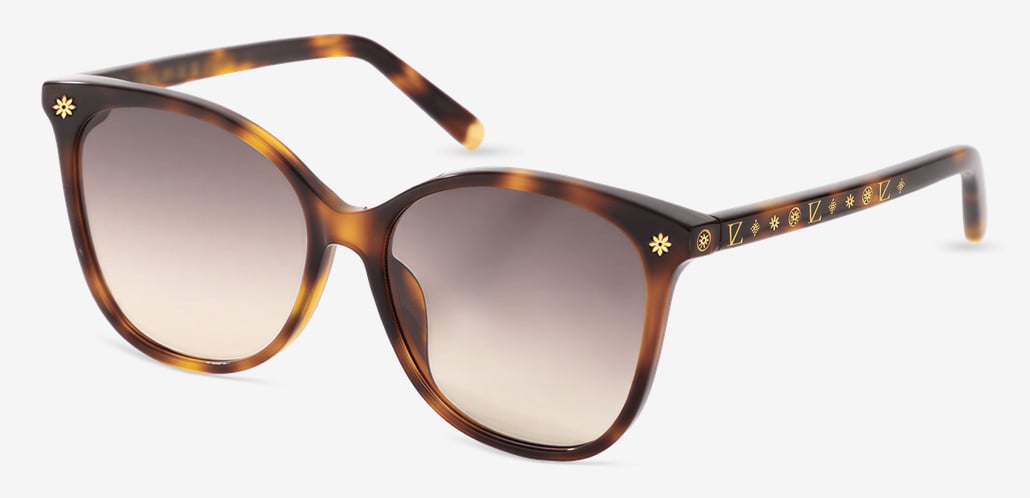
In 2026, '90s-style retro sunglasses (small ovals, slim rectangles) sit at the top of the roughly 30-year revival cycle, so plan on them feeling current for a season or two, not a decade. '70s oversized frames and '50s cat eye or browline shapes have returned so often that they behave more like classics. Spend less on the first group, more on the second, and adjust for how sunny your city is.
The Revival Clock: A 1937 Fashion Rule, Applied to Retro Sunglasses
In 1937, the fashion historian James Laver, a longtime curator at London's Victoria and Albert Museum, published a timeline in his book Taste and Fashion. It describes how people tend to feel about a style as it ages. The part that matters for retro sunglasses is what happens after a look's heyday:
| Years after | Laver's word |
|---|---|
| 1 | Dowdy |
| 10 | Hideous |
| 20 | Ridiculous |
| 30 | Amusing |
| 50 | Quaint |
| 70 | Charming |
| 100 | Romantic |
| 150 | Beautiful |
Two honest caveats before you lean on it. Laver was writing about clothing, not eyewear, and he was writing long before social media. Since then, writers have pinned nostalgia waves to cycles of 12 to 15, 20, 30 or 40 years, and Slate's culture desk once called most of that pattern-spotting anecdotal. The version with the most staying power is the "nostalgia pendulum," which puts the swing at about 30 years: roughly the time it takes for kids who grew up with a culture to become the adults who design, cast and market the next one.
So treat the Revival Clock as a planning tool, not a forecast. It won't tell you what will be cool next June. It will tell you which kind of revival you're buying into.

How to read the clock for any pair of retro sunglasses
- Name the year the shape is quoting. Product descriptions usually say it; if not, the table in the next section covers the common shapes.
- Subtract that year from 2026.
- Find the zone below.
The zone names and boundaries are ours, drawn from Laver's intervals and the 30-year pendulum. They are rules of thumb; a shape can sit near a line.
Reading the Clock in 2026: Where Today's Retro Sunglasses Sit
Right now the clock points at two places at once: the mid-'90s, about 30 years back, and the mid-'70s, about 50 years back. That lines up with what 2026 fashion coverage keeps showing. Good Morning America's spring roundup led with '90s-inspired ovals and oversized retro aviators, and other summer edits described a '70s revival built on ovals and rounded squares in tortoise or black acetate.
| Retro sunglasses shape | Usually quotes | Years back | Laver's word | Zone | Planning horizon |
|---|---|---|---|---|---|
| Small oval or slim rectangle, thin metal or thin acetate | Mid-1990s | About 30 | Amusing | Peak | 1–2 years |
| Wraparound shield or oversized "bug-eye" | Mid-2000s | About 20 | Ridiculous | Peak (early) | About 1 year |
| Oversized square or round, often with gradient lenses | Mid-1970s | About 50 | Quaint | Return | 3–4 years |
| Large metal aviator | Late 1970s | About 47 | Between amusing and quaint | Return | 3–4 years |
| Cat eye with upswept corners, or browline with a heavy top rim | 1950s | About 70 | Charming | Settled | 4+ years |
A few things the table makes easy to see:
- The 2000s row is the tell. Laver's scale says a 20-year-old look should read as "ridiculous." Shields and bug-eye frames are selling anyway. That's the clearest sign the cycle runs faster than it did in 1937, and a reason to keep your planning horizon short for anything in the Peak zone.
- Small round metal frames sit in two places. They quote both the 1930s and the late '60s, so they're always partly settled and partly returning. That's a big part of why round retro sunglasses never fully leave.
- The same pair reads differently by age. A '90s oval looks new to someone born after 2000 and looks like a callback to anyone who wore the original. Neither reading is wrong; just know which one you're dressing for.
The planning horizons in the last column are our working assumptions, not predictions. They exist so you can do the math in the next section. If you know you'll wear a peak-zone pair for five years regardless, use five.
Cost per Sunny Day: What Retro Sunglasses Really Cost Where You Live
Price tags compare badly across cities, because a pair of sunglasses gets used on sunny days, and the US is wildly uneven on those. Here's the math we use instead.
For "sunny days," we start from NOAA's Comparative Climatic Data, which counts the average days per year when clouds cover at least 80% of the daytime sky. Subtract that from 365 and you get the days with real sun in them.
| City | Overcast days (NOAA) | Sunny days (365 minus overcast) |
|---|---|---|
| Phoenix, AZ | 70 | |
| Las Vegas, NV | 73 | |
| Los Angeles, CA | 103 | |
| Miami, FL | 115 | |
| Denver, CO | 120 | |
| New York, NY | 132 | |
| Dallas, TX | 133 | |
| Atlanta, GA | 149 | |
| Boston, MA | 164 | |
| Chicago, IL | 176 | |
| Seattle, WA | 226 |
Nobody wears sunglasses every sunny day, so pick a share that fits your life. Someone who commutes by car or walks a dog at noon might hit 70%; someone who works indoors and drives at dawn might be closer to 30%. The examples below use 50%, which gives Seattle about 70 wear days a year, Chicago 95, New York 117 and Phoenix 148.
| City (wear days a year) | $15 pair, worn 1 year | $45 pair, worn 2 years (Peak-zone shape) | $45 pair, worn 4 years (Settled-zone shape) | $180 pair, worn 2 years (Peak-zone shape) |
|---|---|---|---|---|
| Seattle (70) | $0.21 | $0.32 | $0.16 | $1.29 |
| Chicago (95) | $0.16 | $0.24 | $0.12 | $0.95 |
| New York (117) | $0.13 | $0.19 | $0.10 | $0.77 |
| Phoenix (148) | $0.10 | $0.15 | $0.08 | $0.61 |
What the numbers say:
- Where you live roughly doubles or halves the cost. The same pair costs about twice as much per day in Seattle as in Phoenix, simply because it gets worn half as often.
- The cheap pair only wins if it lasts. A $15 pair looks like a bargain on paper, but that column assumes it survives a full year and you still like it. If a hinge gives out in month three, the Seattle figure jumps from $0.21 to about $0.86 a day.
- Years beat price. A $45 settled-zone pair kept for four years is the cheapest option per day in every city on the list.
- Designer money buys the most in the Settled zone. The same $180 spent on a settled shape and worn for four years drops to $0.30 a day in Phoenix and $0.64 in Seattle, half its cost as a two-year trend pair.
Putting It Together: Matching Your Budget to the Clock
Once you know a pair's zone and roughly how many days you'll wear it, the budget question mostly answers itself. Find your row and column.
| Your retro sunglasses sit in the… | Fewer than about 100 wear days a year (Seattle, Chicago) | About 100 wear days or more (New York, Dallas, Miami, Phoenix) |
|---|---|---|
| Peak '90s ovals, 2000s shields | Keep the spend low. Buy the version you'll wear this year, not the one you'd keep forever. | Mid-price makes sense. You'll put in enough days for a solid hinge and a better lens to show. |
| Return '70s oversized, large aviators | Mid-price. Pick a colorway that would work in any decade, like tortoise or black, over a seasonal color. | Mid-price to higher. This is where better build starts paying for itself. |
| Settled Cat eye, browline | Spend on build quality, not trend details. | Your best place for the biggest budget. |
Before you pay more for any pair, check three things that the cost math quietly depends on:
- The lens spec is stated. Look for UV400 in the product details. It's a specification, so a listing either states it or it doesn't.
- You can see it on your face first. Scale is what makes or breaks a peak-zone shape: a small oval that's a few millimeters too small reads as costume. Use a virtual try-on, or compare the frame width on the product page with a pair you already own.
- The return window covers your doubt. If you're unsure a trend pair is you, the return policy is part of the price.
If you want to browse with the clock in mind, Aoolia's retro sunglasses collection tags every frame by where its retro shows. The Shape tag is where most '90s ovals and '70s oversized frames live; the Brow Line tag holds most settled-zone browlines. Most frames there support Virtual Try-On.
Quick Answers About Retro Sunglasses
Are retro sunglasses still in style in 2026?
Yes. Two eras are active at once: '90s-style small ovals and slim rectangles, which sit about 30 years back at the peak of the revival cycle, and '70s-style oversized frames, which are on at least their second return. Cat eye and browline shapes from the '50s behave more like classics than trends.
Will '90s retro sunglasses go out of style soon?
Nobody can date it precisely, but peak-zone looks turn over fastest. Plan on one to two years of feeling current and budget accordingly; if you still love the pair after that, every extra year lowers its cost per sunny day.
How much should I spend on retro sunglasses?
Divide the price by the sunny days you'll actually wear them over the years you expect to keep them. Using NOAA cloud data and a 50% wear share, a $45 pair kept four years works out to about 8 to 16 cents per sunny day across Phoenix, New York, Chicago and Seattle.
Which retro sunglasses last longest stylistically?
Shapes that sit 70 or more years back on the Revival Clock, such as cat eye and browline frames, and shapes that quote two eras at once, such as small round metal frames. Both have returned often enough that they rarely read as dated.
Sources
- James Laver's timeline from Taste and Fashion (1937): Wikipedia, James Laver; Fashion-Era, Laver's Law
- Competing nostalgia-cycle claims: Slate, "The 'Golden 40-Year Rule'…" (2012)
- The 30-year nostalgia pendulum (Metzger, 2017), as summarized by the University of Richmond
- 2026 sunglasses coverage: Good Morning America via AOL (May 2026); AE World, summer 2026; 1-800 Contacts, 2026 glasses trends
- Overcast days by US city, NOAA Comparative Climatic Data, compiled by Current Results