
Aviator prescription glasses: what changes when the lens isn't tinted
Almost every complaint about this frame comes back to one thing — a dark lens was doing four jobs nobody noticed, and a clear lens stops doing them.
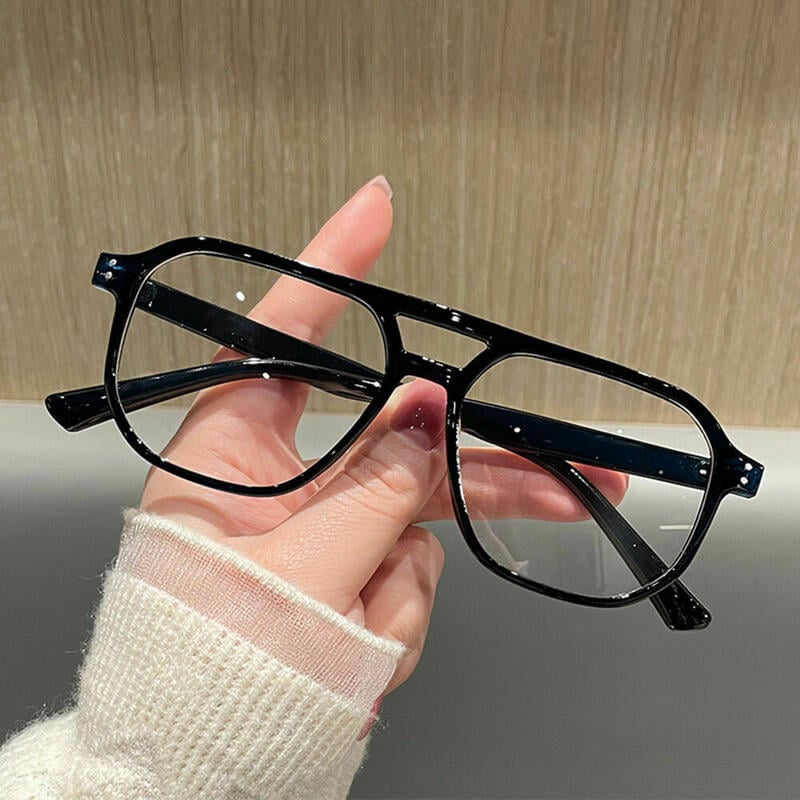
Nearly every frame shape on the market was born as an eyeglass. Rectangles, cat-eyes, browlines, ovals — all of them were drawn around a clear lens, and sunglass makers borrowed them later. The aviator went the other direction. It was designed as a sunglass, and the aviator prescription glasses you can buy today are largely that same frame front with a different lens dropped into it.
That isn't a criticism. The shape has real advantages as everyday eyewear, and a few of them are genuinely hard to find elsewhere. But it does explain something useful: almost every complaint people have after buying aviator prescription glasses traces back to the same root cause. A dark lens was quietly doing several jobs, and when you make the lens clear, those jobs stop getting done.
So instead of another rundown of the shape's history, here is the practical version — what the tint was covering, what carries over cleanly, and what to actually check before you buy.
Four things a dark lens was hiding
-
The thickness of the lens edge
A lens that corrects nearsightedness is thin in the middle and thickest at its outer edge. How thick depends on two things: the strength of the correction, and how far that edge sits from the centre of the lens. Aviators are large in both directions, so the edge is a long way out.
On a sunglass this is invisible — dark lens, dark edge, one solid shape. Make the lens clear and the edge becomes a visible band around the inside of the rim, sometimes with faint concentric rings in it. On a thin wire rim there is nothing to hide behind.
Correction strength What you'll typically notice in a large aviator Under -2.00 Edge is thin enough that frame size barely matters -2.00 to -4.00 Visible edge in a large lens; a higher-index material handles it -4.00 and stronger Frame size becomes the main lever — a smaller lens does more than any coating Scroll the table sideways to see both columns.
Two practical moves: choose a higher-index lens material, which thins the edge for the same correction, and be willing to drop a size. A 52 mm aviator and a 58 mm aviator look far more alike on a face than they do in a lens edge. Half-rim and rimless aviators are the extreme case — with no rim at all, the edge is exposed on every side.
-
Where your eyes actually sit in the frame
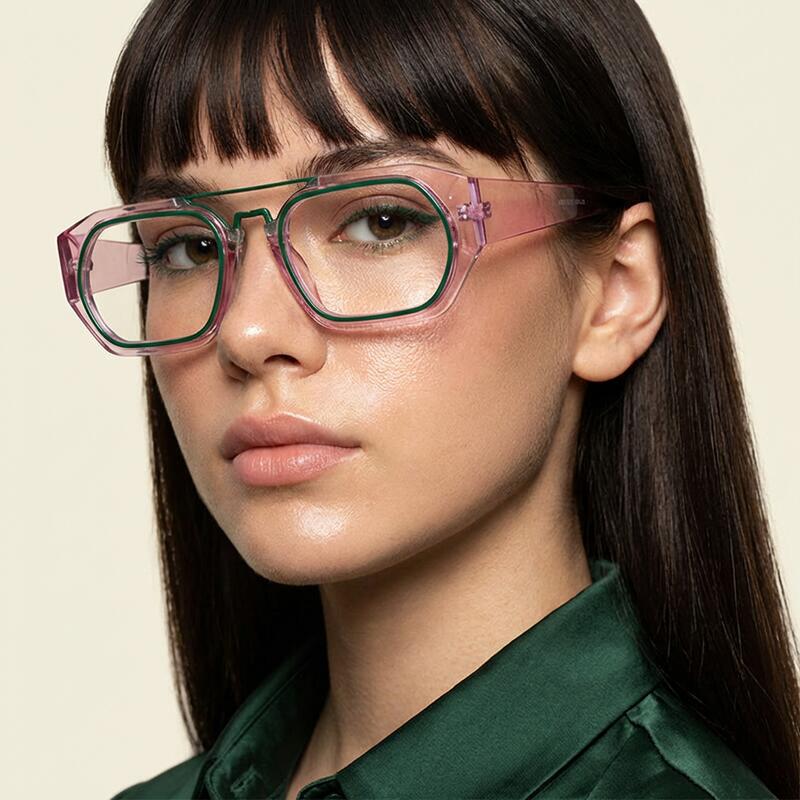
Aviator lenses are tall. A rectangle might have a 36 mm lens height; aviators commonly run 45 to 50 mm. That extra height is the shape's signature, and it also means your pupils sit noticeably higher within the lens opening than they would in almost any other frame.
-
Behind a tint, nobody can tell. In clear lenses it's the first thing people see. When an aviator slips 3 mm down the nose, the wearer's eyes end up near the top of the lens, and the effect reads as these glasses are too big for my face — even when the width is perfectly correct.
-
The check takes ten seconds. Put the frame on, take a straight-on photo, and look at where your pupils land vertically. They should sit at or slightly above the midpoint of the lens opening. If they're much higher than that, the frame is sitting too low, and that's usually fixable rather than fatal — which is what the nose pads are for.
-
Reflections
Aviator lenses are large, and the shape carries more forward tilt than most frames: the front angles down toward the cheeks, because it was originally meant to shield from above and below. Big surface plus a steeper tilt means a lot of area catching light from off-axis.
A tinted lens absorbs most of what hits it. A clear one doesn't. That's why aviator prescription glasses show up in photographs with pale discs where the eyes should be more often than smaller shapes do, and why they can throw distracting reflections back at you under overhead lighting.
An anti-reflective coating is a nice-to-have on a small rectangle. On this shape it's closer to a requirement. If you're choosing between spending on the coating or spending on the frame, on an aviator the coating is the better spend.
-
The gap between the frame and your face
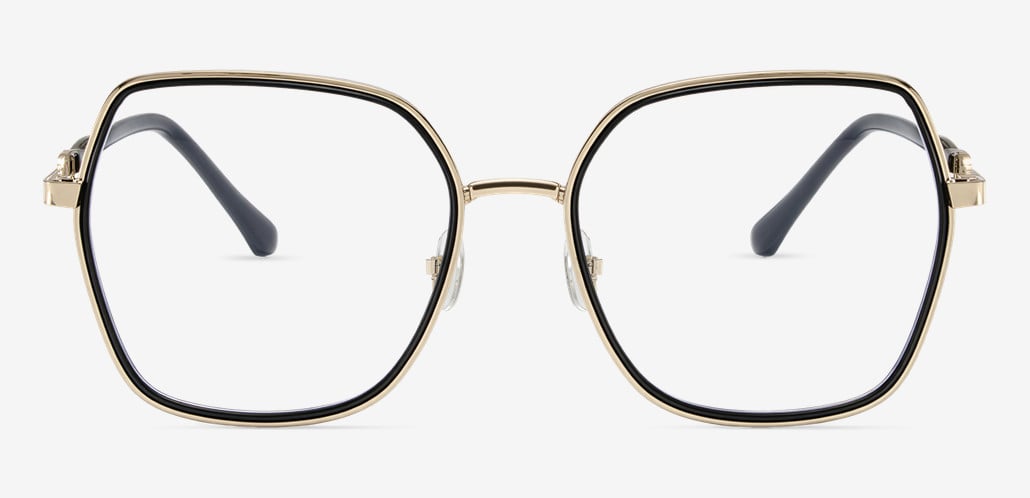
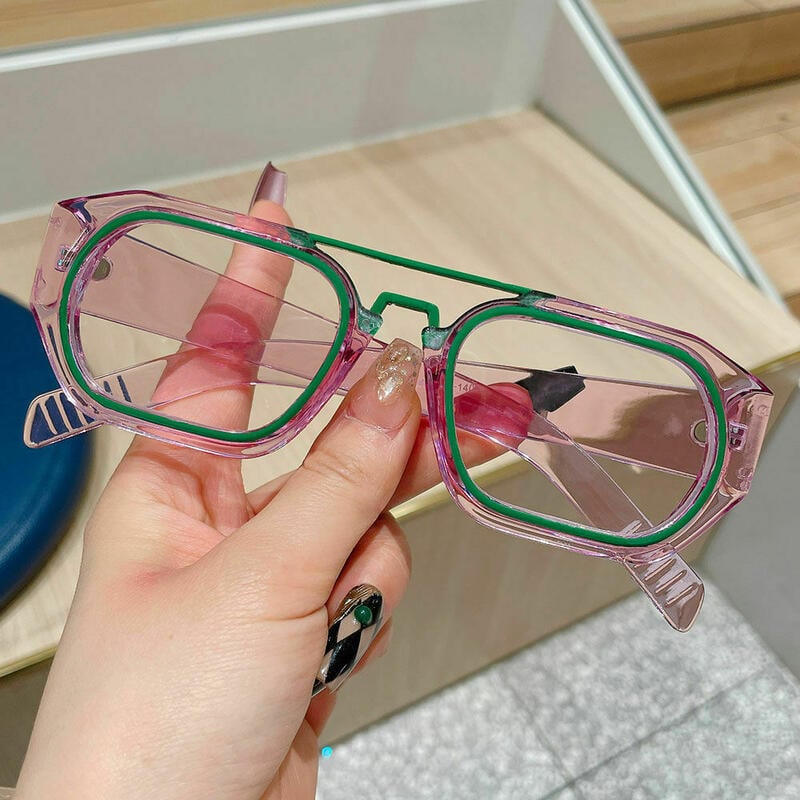
Aviators sit off the face on pad arms — two small wire legs holding the nose pads. Between the top bar, the bridge and your nose there is an open space. On a sunglass the whole zone is dark and it disappears. On clear glasses you can see the bridge wire, the pad arms, your nose, and daylight between all three.
Whether that looks fine or looks odd depends almost entirely on pad arm length versus the height of your nose bridge. If your bridge is low, short arms hold the frame too high and open the gap wide. Longer pad arms, or larger pads, close it.
Three things that transfer better than people expect
The lineage cuts both ways. Some of what the aviator inherited from sunglasses turns out to be worth more in prescription eyewear than it ever was behind a tint.

Adjustable pads matter more the stronger your correction is
Most acetate frames have a fixed saddle bridge moulded into the front. Where that frame sits on your face was decided at the factory, and no amount of adjustment changes it. Aviators mostly don't work that way — the pads bend.
That gives you control over two separate things. The obvious one is vertical position, which fixes the eye-placement problem above. The less obvious one is vertex distance: how far the back of the lens sits from your eye. Vertex distance changes the effective strength of a lens.
≈ 0.13 DThe shift in effective power when a -8.00 lens moves about 2 mm closer to the eye. Under roughly ±4.00 the change is small enough to ignore; above that it isn't, and it compounds if the frame sits well away from where it was measured.
Having a frame you can tune along that axis is genuinely uncommon. It's the aviator's best argument as prescription eyewear, and it's almost never the argument anyone makes for it.
Presence without width
The aviator gets its impact from lens height rather than lens width, which is an unusual combination. Most ways of making a frame look bold — oversized squares, thick acetate, wide browlines — also make it wide, and that's a problem if your face isn't. If you want a frame with real presence but bold frames keep overhanging your temples, the aviator is one of the few shapes that gets you there vertically instead of horizontally.
A wide size range, though a lopsided one
Worth being straight about this. Across our own collection of 65 aviator eyeglass frames the sizes run 1 extra-small, 6 small, 23 medium and 38 large, spread over metal, acetate, TR90, titanium and mixed-material builds. That's a broader range than several other shape categories carry.
But it clearly skews large. If you're shopping for a narrow face, the aviator shelf is genuinely thinner than the shelf for rectangles or ovals — filter by size early, rather than falling for a frame and then finding it exists in one width only.
The technical footnote most guides skip
This one explains a question people ask and rarely get a straight answer to: why some aviator frames are described as unable to take a strong prescription, when the shape itself looks large enough for anything.
Lenses aren't flat. Every lens is made on a base curve, and sunglass lenses are conventionally built on steep ones — the curvature is part of how they wrap and shield. Corrective lenses, particularly stronger nearsighted ones, are made on much flatter curves. Those two things don't automatically fit each other.
A frame front designed around a steeply curved lens has a matching curve built into its eyewire. Drop a flatter lens into it and something has to give: either the front gets flattened during fitting, or the lens is edged to sit in a groove whose curve it doesn't share. Neither is ideal, and both surface as fit problems later.
You can check it yourself in a product photo, if there's a top-down or three-quarter view. A sunglass-derived front curves noticeably from one lens to the other. An eyeglass-first aviator front is close to flat.
A shopping checklist for aviator prescription glasses
Seven things, in the order they're worth checking.
- Match against a pair you already own. Lens width and bridge width within about 2 mm of a frame that already fits is the fastest shortcut there is. Those numbers are printed inside the temple arm, in the format 52▫18-140.
- Check where your pupils land. Straight-on photo; pupils at or slightly above the lens midpoint. Virtual Try-On is accurate enough for a first pass.
- Look at the bottom of the lens. The classic teardrop narrows sharply toward its base; modern flat-base aviators don't. If you'll be reading through the lower part of your lenses, base width matters more than the frame's height does. Our aviator collection tags each frame with how much it tapers.
- Budget for an anti-reflective coating. On this shape specifically it does more visible work than on any small frame.
- Past -3.00, think about material and size together. A higher index plus one size down solves the edge problem far more effectively than either move alone.
- Check the pad arms if your nose bridge is low. Short arms plus a low bridge is the single most common reason an aviator ends up sitting too high.
- Look at the front from above if a photo allows it. Flat front, fewer surprises at fitting.
When an aviator isn't the right call
A guide that only lists strengths isn't much use. Four situations where a different shape is the better answer.

- You want a wide near-vision zone in a multifocal lens. The reading portion sits low, which on a classic teardrop is the narrowest part of the lens. Vertical room isn't the constraint here; horizontal room is. A flat-base aviator handles it — a sharply tapered one doesn't.
- Strong nearsighted correction and you dislike visible lens edges. A smaller frame with a thicker rim profile hides an edge that a large thin-wire aviator simply cannot.
- You need the frame to stay put while moving. Pads are adjustable, which is another way of saying they can shift. For anything active, a frame that grips at the temples beats one balancing on pad arms.
- You've tried aviators before and they slid. Worth taking seriously rather than assuming a different model will behave differently — the mechanism is the same across the shape.
Common questions
Are aviator prescription glasses the same as pilot glasses?
Yes — two names, one shape. "Pilot glasses" is the standard term across much of Europe; "aviator" is what's used in the US. Some catalogues use both, occasionally within the same product line.
Do aviator glasses only come in metal?
No. Thin metal is the original construction and still the most common, but the shape is also made in acetate, TR90, titanium and mixed-material builds. Acetate aviators read softer and warmer, and they usually have a fixed bridge rather than pads — which means you lose the adjustability described above.
Can I put a strong prescription in an aviator?
Usually yes, with two caveats: the lens edge will be more visible than in a smaller frame, and a frame with a heavily wrapped front may not accept a flat lens cleanly. Neither is about the shape itself — both are about size and base curve.
Do aviator frames suit round faces?
More often than the standard advice suggests, because the variable that decides it isn't the outline of the lens. It's the bridge: a double bridge draws a strong horizontal line across the upper face, and where that line falls relative to your brows does more for the overall effect than the teardrop shape does.
Why do my aviators reflect so much in photos?
Large lens area plus forward tilt, both inherited from the sunglass design. An anti-reflective coating is the fix, and it's more noticeable on this shape than on most.
Are aviators unisex?
The shape is. The sizing generally isn't. Frame widths across the category span roughly 128 mm to 145 mm, and that spread will affect how a pair fits you far more than which section of the site it's listed under.
The short version
Aviator prescription glasses are a sunglass design working a second job, and they do it well — but the tint that came with the original was hiding lens edges, eye position, reflections and the gap at the bridge. Clear lenses put all four back on display.
None of that is a reason to avoid the shape. It's a reason to shop it differently than you'd shop a rectangle: pay attention to lens size and material, take the coating seriously, and use the one thing this shape gives you that most frames don't — a pair of pads you can actually adjust.
Browse aviator prescription glasses