
Field guide · Light first, frame second
Prescription Sunglasses for Men: How Dark to Go, and What Happens When You Walk Inside
Most buying guides start with the frame. This one starts with the light you actually live in, and with the moment every guy who wears prescription sunglasses runs into sooner or later.
Here's the moment. You park in a sunny lot, walk into a hardware store, and the aisles go murky. With regular sunglasses you'd just take them off. With prescription lenses, taking them off means trading dim for blurry. So you stand in aisle nine, squinting at drawer labels through a dark lens and wondering whether you ordered the wrong pair.
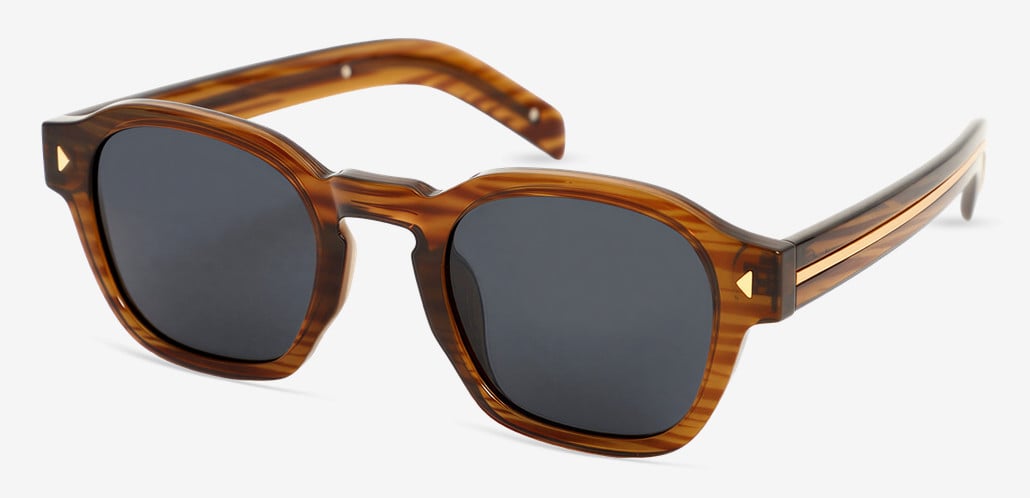
The frame probably isn't the problem. More likely the lens is too dark for your days, or you never planned for that doorway. This guide fixes both. If you already know the look you want, browse Prescription Sunglasses For Men and come back for the lens decisions. If you're still working out what kind of pair to order, the two tools below, the Doorway Gap and the Shade Pattern, settle most of the decision before you look at a single frame.
The short answer
Prescription sunglasses for men are sunglass frames fitted with lenses made to your own glasses prescription, so one pair handles both focus and shade. For most men, a medium-dark lens (filter category 2 or 3) is the everyday pick. Choose the darkness by how even the light is where you spend time outside, not by how sunny your state is. And plan for indoor stops, because a prescription pair can't just come off when you walk inside.
The one difference that changes every other choice
Regular sunglasses become optional the second you step into shade. Prescription sunglasses don't, because they're also your glasses. Every choice you make, from how dark to go and which tint to pick to polarized lenses and a second pair, has to work in the exact places where other people simply pull their shades off.
That's why the usual advice misfires for glasses wearers. "Go darker in sunny places" and "polarized is always better" are written for people who can take their sunglasses off. If you can't, two better questions decide the pair: what happens when you go inside, and how uneven is the light where you spend your time outdoors?
The Doorway Gap: what your eyes do when the light drops
Your eyes adjust to brightness in two directions, at very different speeds. Going from dim to bright is quick: a few seconds of glare and you're fine. Going from bright to dim is slow. The cone cells you rely on for detail and color recover most of their sensitivity in roughly 5 to 10 minutes. The rod cells that handle low light keep adjusting for 20 to 30 minutes.
Now put a lens in front of that. A category 3 lens lets through 8 to 18 percent of visible light. Direct summer sun can reach about 100,000 lux, so outdoors that cut is welcome. A well-lit store, though, sits around 500 lux. Through the same lens, your eyes get the equivalent of roughly 40 to 90 lux, about what a dim hallway offers. A restaurant lit at 75 lux turns into something close to candlelight.
That mismatch between how dark the lens is and how dark the room is is the Doorway Gap. Every man who wears prescription sunglasses lives with it. Which version you deal with depends on the kind of doorway that fills your week.
Door 1 · Under 5 min
The Quick Dip
Gas station, coffee counter, the hardware store run.
What happensYou keep the sunglasses on, because swapping takes longer than the errand. Through a category 3 lens, labels and faces are hard to make out. Category 2 is usually workable.
Your planIf most of your doorways are quick dips, don't go darker than category 2, or pick a gradient lens that's lighter at the bottom, where you read prices and screens.
Door 2 · 30 min or more
The Sit-Down
Restaurant, office, a friend's living room.
What happensYou'll swap every time. How dark the lens is barely matters here. What matters is whether your clear pair is actually with you.
Your planKeep the clear pair in a case on you, not in the car. If you don't carry a bag, a slim hard case fits a jacket or cargo pocket.
Door 3 · No door at all
The Dim Outdoors
Covered patios, stadium concourses, a trail under heavy trees, the last hour before sunset.
What happensIt's too dark to see detail and too bright for your clear pair to feel right. This is where a dark lens starts to feel like a bad purchase.
Your planDepending on how often it happens: a lighter tint, a light-reactive lens, or a second sun pair in a lighter shade.
Which door runs your week? Walk through a normal seven days in your head.
- If quick dips win, a lighter lens beats a darker one.
- If sit-downs win, buy whatever darkness the outdoors calls for and solve the carrying problem instead.
- If the dim outdoors wins, a single dark lens will frustrate you. Look at light-reactive lenses or a lighter category.
One upside of a dark lens. Vision research has long shown that wearing dark lenses in bright daylight helps your eyes adapt faster when you later move into dim light. So once you do swap to your clear pair inside, the adjustment goes quicker than it would after an afternoon outdoors in clear lenses.
The Shade Pattern: choose darkness from the place, not the forecast
Lens darkness is graded in five filter categories under the international sunglass standard ISO 12312-1, and you'll see these numbers on many lens spec sheets. Each one is defined by how much visible light gets through.
0
80–100%
clear
1
43–80%
light
2
18–43%
medium
3
8–18%
dark
4
3–8%
very dark
Percent = share of visible light that reaches your eyes. Category 4 is not suitable for driving.
Most advice ties darkness to how sunny it is. Sunshine matters, but for glasses wearers a better guide is how even the light is where you spend your outdoor minutes. Your eyes settle into steady light at almost any level. What makes a dark lens feel wrong is light that keeps changing in front of you.
Pattern 01
Open
Wide, unbroken light with almost nothing in view sitting in shade. Beaches, open water, golf fairways, ballfield bleachers, snowfields, big parking lots.
Category 3Consider polarized
Nothing in front of you is shaded, so there's no dark corner where detail gets lost. Polarized lenses earn their keep near water and snow.
Pattern 02
Striped
Hard sun and hard shade in alternating bands. Downtown sidewalks between buildings, stadium seats half under the overhang, a backyard split by the house's shadow.
Category 2Or gradient
Every shade band is a small doorway. A category 3 lens turns each one into a murky patch you walk through half-blind.
Pattern 03
Dappled
Light broken into spots by leaves. Wooded trails, tree-lined streets, shaded tennis courts, the dog park.
Category 1–2Brown or copper
Contrast matters more than darkness here. You need to see roots, curbs and the edge of the path. Warm tints usually make edges stand out more than gray.
Pattern 04
Shifting
The light changes across the day: open sun at the morning game, striped streets at lunch, a dappled park at dusk.
No single categoryLight-reactive or two pairs
One compromise darkness will be wrong half the time. A light-reactive lens, or one dark pair plus one lighter pair, handles it better.
How to use it: pick the pattern where you spend the most outdoor minutes, then check the runner-up. If the runner-up is Dappled and you've landed on category 3, think twice. That's the combination most likely to feel too dark.
Once you have a darkness and a doorway plan, the frame is the easy part. Compare shapes, sizes and polarized options in our Prescription Sunglasses For Men collection, and use virtual try-on to see the fit on your own face before you order.
Three weeks, three different answers
Here's how the two tools play out for three different routines. Same method, three different pairs.
Example A
The downtown commuter
- 7:40 AMWalk to the train between office towers: Striped
- 12:15 PMSandwich shop line: Quick Dip
- 6:30 PMDinner out: Sit-Down
Pair: category 2 gray, or a gradient. The clear pair rides in a slim case in his jacket.
Example B
The weekend angler
- 6:30 AMOn the lake: Open
- 11:00 AMBait shop: Quick Dip
- 1:00 PMLunch at the marina grill: Sit-Down
Pair: category 3 polarized. A hard case for the clear pair lives in the tackle bag. He accepts one dim minute in the bait shop.
Example C
The sideline dad
- 9:00 AMYouth soccer on an open field: Open
- 2:00 PMTrail walk with the dog: Dappled
- 7:30 PMGrilling under the patio cover: Dim Outdoors
Pair: a light-reactive everyday lens, or a category 2 brown sun pair plus his clear pair for evenings. A single category 3 lens is the wrong buy for this week.
These are composite examples written to show the method, not customer stories.
One pair, two pairs, or a different kind of lens?
There are five common ways to get shade when you need a prescription. Instead of ranking them by price, here's how each one handles the two tests above.
Dedicated prescription sunglasses
DoorwayYou need a clear pair with you for sit-downs.
ShadeThe best fit for Open and Striped light, because you choose exactly the darkness and tint.
Trade-offTwo pairs to keep track of.
Light-reactive (photochromic) clear lenses
DoorwayOne pair, no swap.
ShadeGood for Shifting days.
Trade-offThey can take several minutes to clear fully indoors and get less dark in hot weather. They also barely darken behind most car windshields, which block much of the UV that triggers them.
Clip-ons and magnetic sun covers
DoorwayThe fastest swap of all: flip up or pull off.
ShadeFine in Open light, with less coverage at the sides.
Trade-offAn extra layer to keep clean, and the clip only fits one frame.
Fit-over sunglasses
DoorwayEasy; they slide off over your glasses.
ShadeFull coverage, sides included.
Trade-offBulk, and a look most men put up with rather than choose.
Contacts with regular sunglasses
DoorwayThe easiest of all: the shades just come off.
ShadeAny lens you like.
Trade-offDepends on how many hours you comfortably wear contacts. FDA guidance is to keep contact lenses away from water, which rules them out for swimming and makes lake days trickier.
For men who wear glasses all day, a dedicated sun pair plus a clear pair is still the setup with the most control, as long as the clear pair actually travels with you.
Lens choices worth your attention
Once darkness is settled, these are the extras that change how a pair performs. Each one is matched to the patterns where it helps most.
Polarized
Filters glare reflected off flat surfaces such as water, snow, wet pavement and car hoods. The catch: some phone, watch and dashboard screens can look dark or patchy at certain angles. Strongest in Open light.
Gray tint
Changes colors the least, which makes it a safe default. It's also the one to start with if you have red-green color blindness, which affects roughly 1 in 12 men. Brown and amber shift colors more, so try one before committing.
Brown, amber or copper
Warms the view and makes edges and textures stand out. This is the tint that pays off in Dappled light, on trails and on tree-lined streets.
Green
Sits between gray and brown: fairly true color, with a little more contrast than gray.
Gradient
Dark at the top, lighter at the bottom. Handy in Striped light and for reading a phone. Less helpful when glare comes up off water, because the lightest part of the lens faces it.
Mirror finish
Hides your eyes and cuts a little extra light, but the base tint does most of the work. Scratches show more on a mirrored surface than on a plain tint.
Back-side anti-reflective coating
When the sun is behind you, light can bounce off the inside of the lens and into your eyes. An anti-reflective coating on the back surface cuts that bounce, which you'll notice most in late-afternoon sun.
Frame details that matter more once the lenses are dark
-
Lens size and your numbers
With a stronger nearsighted prescription, a wider lens means a thicker outer edge. With a farsighted one, a bigger lens means a thicker center. If your numbers are strong, choose a frame sized to your face rather than going oversized.
-
Full rim versus rimless
A full-rim front hides the lens edge, while rimless shows all of it. For most prescription sun lenses, full rim is the more forgiving choice.
-
Curve
Deeply wrapped sport frames can only take a limited range of prescriptions. A gentle curve is the usual middle ground for men who want a sporty look with everyday lenses.
-
Nose support for long Open days
Adjustable nose pads let a pair sit higher or lower and spread its weight differently. That matters on a six-hour lake day far more than on a ten-minute errand.
-
The case is part of the plan
If your week is mostly Sit-Downs, you'll be carrying two pairs. A metal or thin-profile frame usually fits a slimmer case than a chunky acetate one, which makes it more likely the case comes with you.
What to have ready before you order
- A copy of your current glasses prescription. Under the FTC Eyeglass Rule, your eye doctor has to give you a copy after your exam, whether or not you ask for it. A contact lens prescription isn't the same document and won't work for glasses.
- Your pupillary distance, the distance between the centers of your pupils in millimeters. Some prescriptions list it. If yours doesn't, ask at your next visit or follow the retailer's measuring steps.
- Your Shade Pattern (Open, Striped, Dappled or Shifting) and the darkness it points to.
- Your Doorway plan: where the clear pair will live when the sun pair is on your face.
- A frame you've seen on your own face, in a mirror or with virtual try-on.
Prescription Sunglasses for Men: FAQ
How dark should prescription sunglasses be?
For most men, category 2 or 3. Category 3 (8–18% of light gets through) suits Open settings like beaches, water and snow. Category 2 (18–43%) is easier in Striped or Dappled light and if you make lots of quick stops indoors. Category 4 is for extreme brightness only and isn't suitable for driving.
Can I wear prescription sunglasses indoors?
For a minute or two, yes. Any longer and a dark lens makes most rooms too dim to see detail comfortably. If you'll be inside for half an hour or more, switch to your clear pair.
Should prescription sunglasses for men be polarized?
If you spend outdoor time around water, snow or wide paved areas, polarized is worth it. If you check screens outdoors a lot, see how your phone and watch look through polarized lenses before you commit.
Can light-reactive lenses replace prescription sunglasses?
They can, if your days follow the Shifting pattern and you hate swapping pairs. Expect slower clearing indoors, less darkening in hot weather and very little darkening behind a car windshield.
What lens color works best for color-blind men?
Gray, because it shifts colors the least. If you're curious about brown or amber, try them before buying. Some men with red-green color blindness find colors harder to tell apart through warm tints.
Do prescription sunglasses feel different from my regular glasses?
Often a little at first. A larger lens or a more curved front can make the same prescription feel slightly different for a few days. If things still look off after a week, have the pair and the prescription checked.
Light first, frame second
Most men shop for prescription sunglasses the way they'd shop for regular shades: find a frame they like and pick the lens at the end. Turn that around. Work out which door runs your week, find your Shade Pattern, and the darkness, the tint and the number of pairs mostly decide themselves.
Then go find the frame. Start with Prescription Sunglasses For Men at Aoolia, try a few on with virtual try-on, and match the lens to the light you actually live in.
How this guide was put together. Filter categories follow the definitions in ISO 12312-1. Light-adaptation timings and lux figures are rounded, commonly cited values from vision-science and lighting references. The examples are composites written to show the method. This article is general information, not medical advice; questions about your eyes belong with your eye doctor.