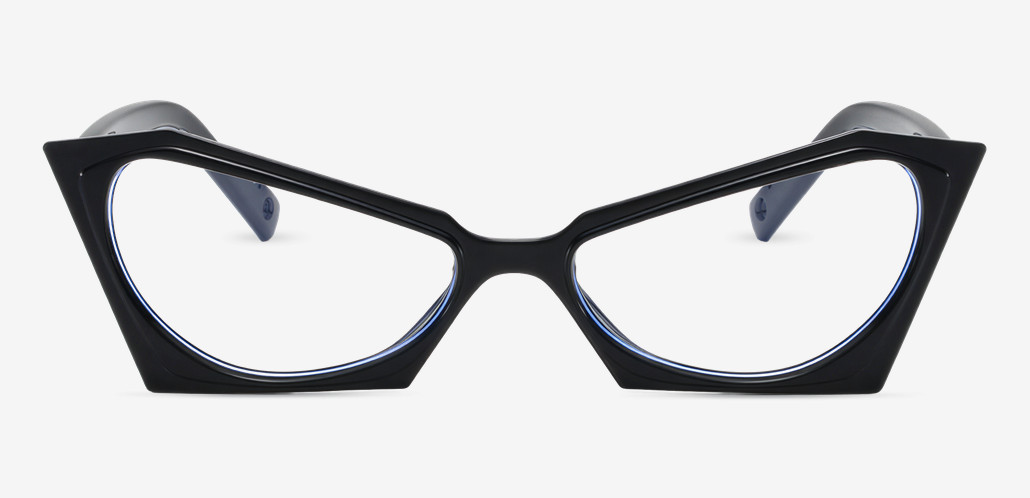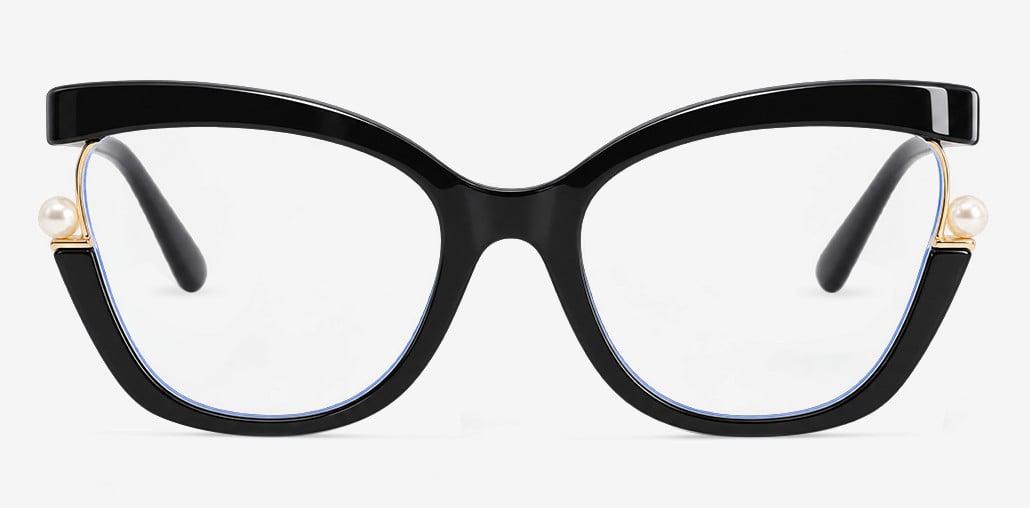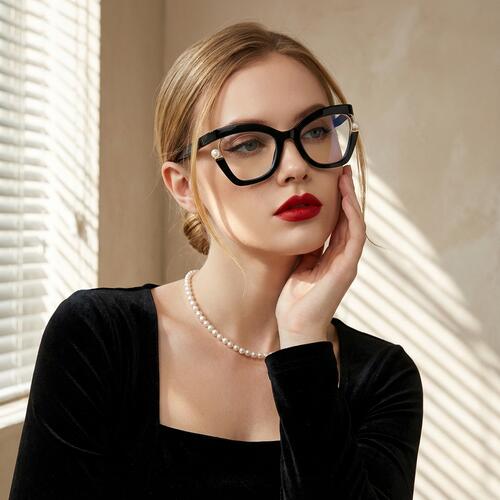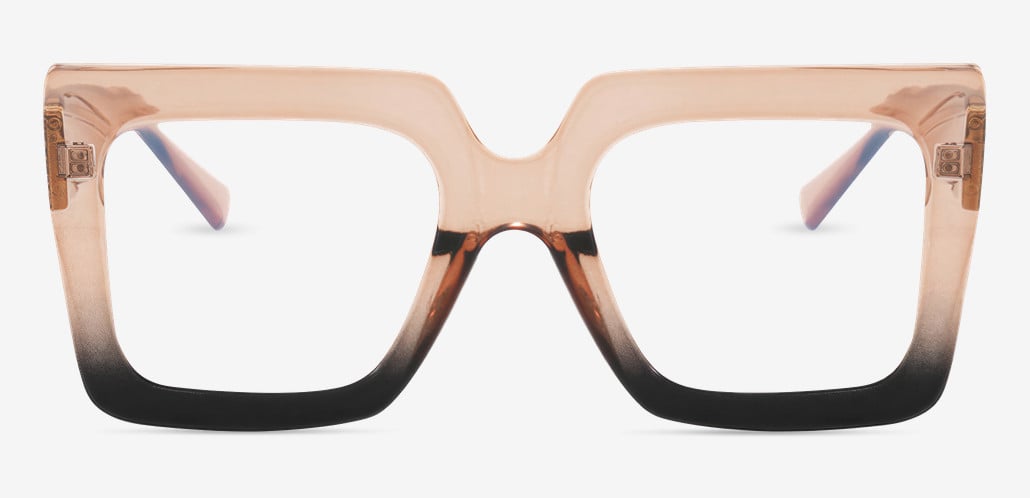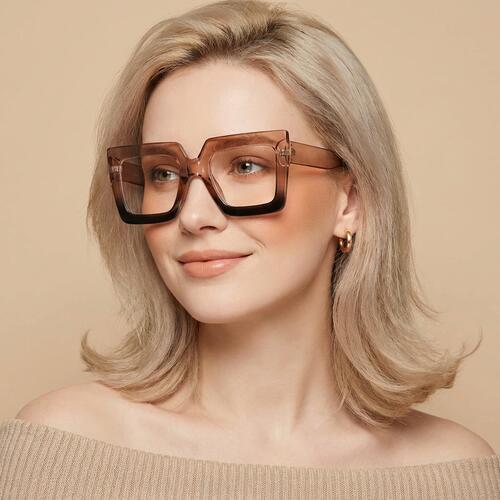

Face shape · The rule everyone repeats
Can You Wear Square Glasses With a Square Face? The honest answer
Search for glasses for a square face and you will hit the same sentence within about four seconds, on almost every site selling eyewear: avoid square and rectangular frames. It is stated as settled. No caveats, no conditions, no explanation of what exactly goes wrong.
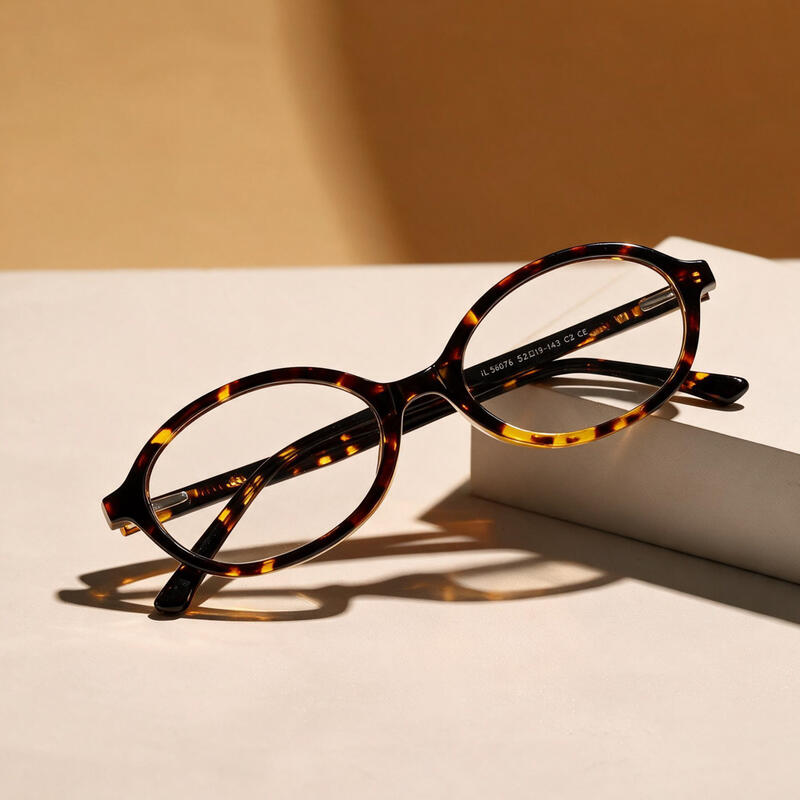
Strip the standard advice down and there is one mechanism underneath it — and it has almost nothing to do with the overall shape of the frame.
Where the rule actually comes from
The advice is older than online eyewear. It comes out of general styling theory — the same body of thinking that produced rules about vertical stripes and hemlines — and its core idea is contrast: if a feature is strong, introduce an opposing line to balance it. Curves against angles, angles against curves.
It is a reasonable heuristic. It is not a measurement, a fit constraint, or an optical one. Nothing physically goes wrong when a square frame meets a square jaw. Nothing sits badly, nothing pinches, nothing is harder to make. The entire objection is visual, which means the entire objection is subject to how strongly the visual effect actually registers — and that varies enormously.
There is also a commercial reason the rule stayed so clean. Face-shape categories are a merchandising system. Sorting six hundred frames into six face shapes gives shoppers a way in, and a way in is worth a lot when someone is standing at the top of a very long product grid. But merchandising rewards rules that are easy to state, not rules that are accurate. “Round, oval, cat-eye — avoid square” fits on a filter chip. “It depends on corner radius, rim weight, lens depth and how wide the frame sits relative to your cheekbones” does not.
None of that makes the advice dishonest. It makes it compressed. And compression is where the useful part got lost.
The one thing the rule is genuinely right about
A square face has a strong horizontal line running along the jaw. If the lower edge of a frame runs roughly parallel to that line, at a roughly similar width, you now have two horizontal lines stacked a few centimetres apart. The eye reads repetition as emphasis.
That is the effect people are describing when they say a square frame makes a square face look boxier — not the frame’s corners, not its “squareness” as a category, but the fact that its bottom edge is drawing a second version of a line your face already has.
Which means the fix is not “buy a round frame.” The fix is anything that stops those two lines from stacking — and there are several, most of which do not require abandoning angular frames at all. It also explains why the standard advice feels so unsatisfying to follow. It tells you to change the category when the thing that matters is a detail inside the category.

What the word “square” flattens
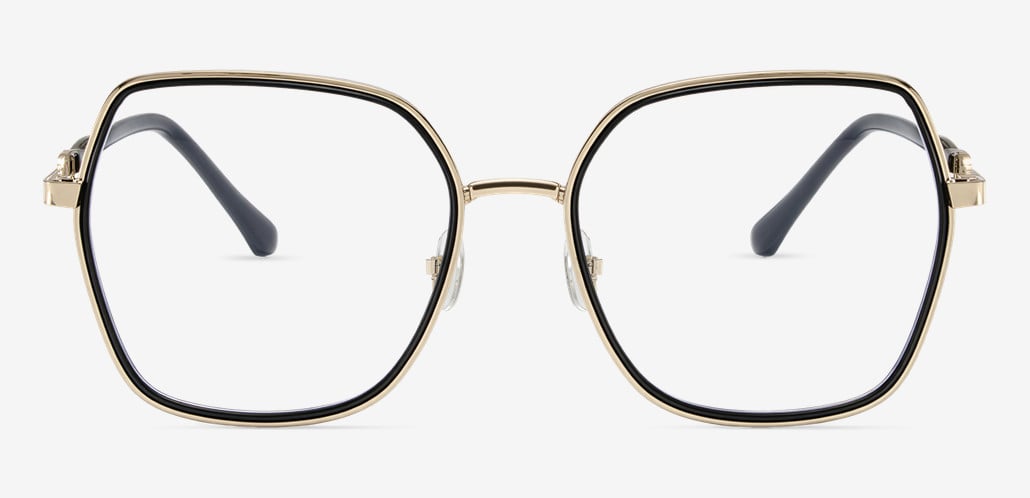
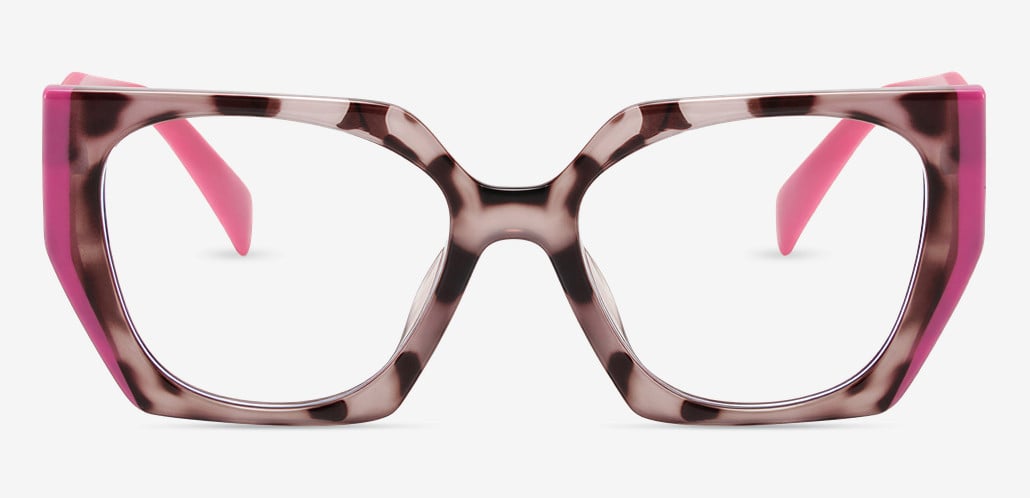
Filed under “square” you will find frames that behave completely differently on the same face. Four variables do most of the work.
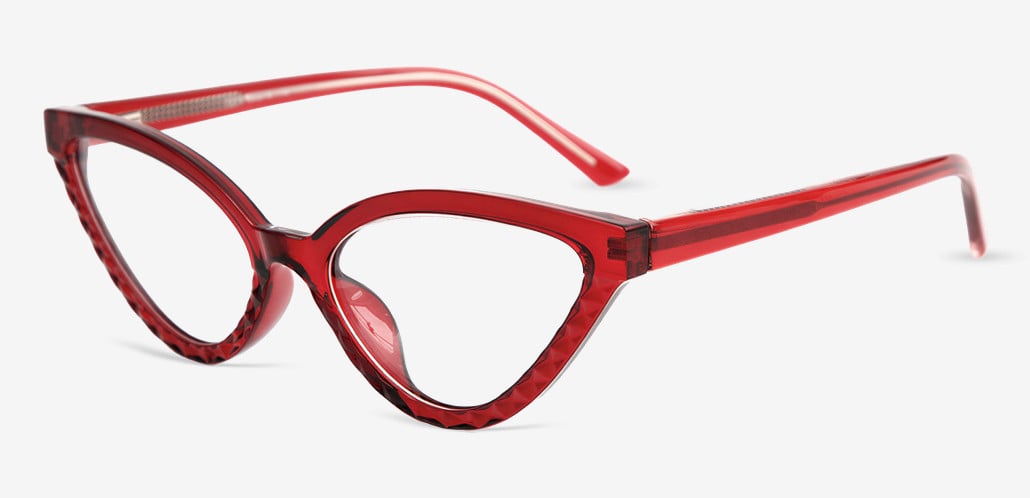
-
Corner radius
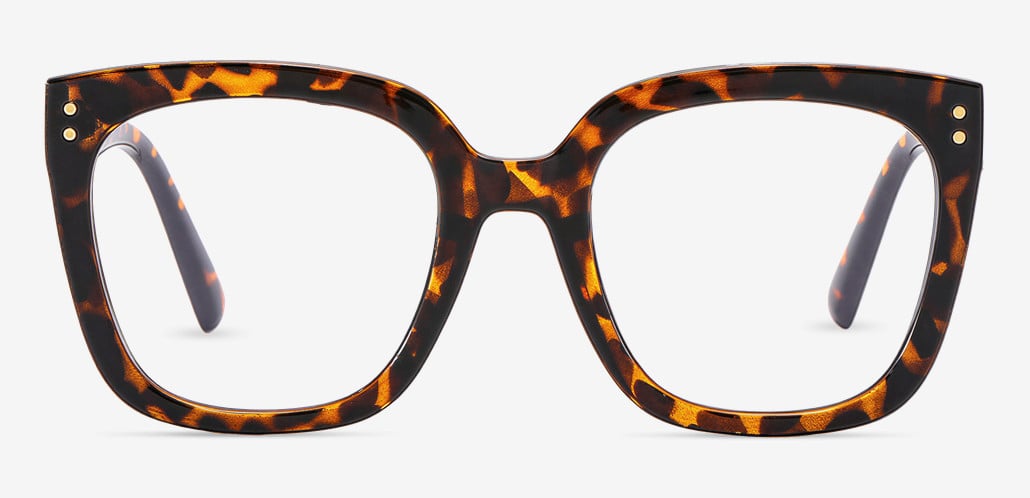
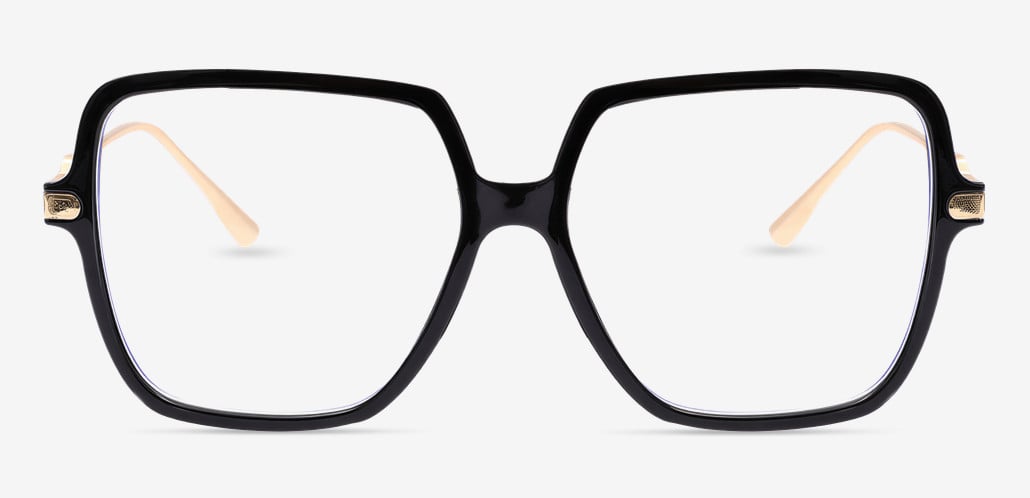
A frame with softened corners and one with sharp mitred corners are both sold as square. They are not the same object. This is the biggest visual difference between two frames of identical shape, and it is the one spec nobody publishes — you read it off the photo. Look at the outer bottom corner and ask whether it turns or whether it stops.
-
Rim thickness and colour contrast
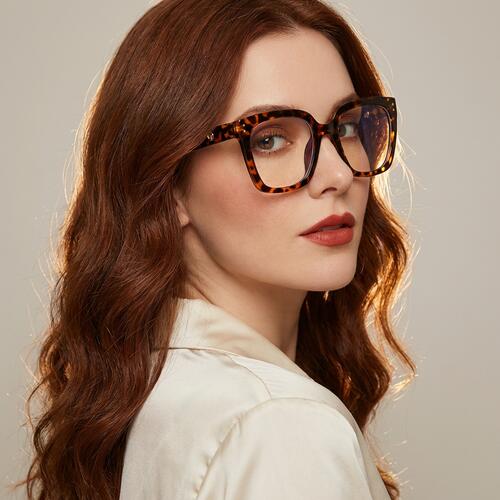
A line only reads if it is visible. A thin silver metal rectangle draws a faint line against skin; a thick black acetate rectangle draws a heavy one. Same geometry, wildly different volume. This is why people report looking fine in one rectangular frame and terrible in another and cannot explain why — the shape was never the variable that changed.
-
Lens depth
A shallow frame sits high, with its bottom edge up on the cheek and a long way from the jaw. A deep frame drops that edge down towards it. Two lines far apart do not read as a pair; two lines close together do. Lens height is listed on most product pages and almost nobody looks at it.
-
Total width against your face
Independent of shape, and it causes more bad outcomes than shape does. If a frame is narrower than the widest part of your face, your face continues past it on both sides and the jaw reads wider by comparison. People experience this as “square frames make my face look wide” and blame the shape. It was the width.
Change any two of those four and a square frame stops doing the thing the rule warns about.
The question underneath the question
There is an assumption buried in all of this that nobody states: the advice takes for granted that you want to look less square.
That is an aesthetic premise, not a fact about faces. Plenty of people with strong jawlines have built their whole look around exactly that feature and have no interest in softening it. Matching rather than contrasting is a legitimate strategy — the same logic as monochrome dressing, or wearing a sharp-shouldered coat because you like sharp shoulders. Repetition reads as emphasis, and emphasis is sometimes the point.
So the real failure mode is not matching. It is matching by accident — buying an angular frame because it was the first thing you liked, without noticing it was going to amplify something, then feeling vaguely wrong in it without being able to name why.
If you want the strong angular look, take it deliberately and lean in: heavy rim, sharp corners, high-contrast colour, the whole thing. If you want it softened, the standard advice is fine. The uncomfortable middle is where people end up when they follow a rule they did not understand.

When the answer is genuinely no
Being honest about this cuts both ways. There are conditions where a square frame on a square face does not work, and pretending otherwise would be its own kind of sales copy.
The failure is almost always stacking. One angular signal is a style choice. Four at once is a problem.
Every one of these pushes the same direction. The effect compounds.
The practical rule is to pick one loud element and soften the rest. Sharp corners with a thin metal rim, fine. Thick black acetate with rounded corners and a shallower lens, fine. Sharp corners plus thick black plus deep lens, not fine — and no amount of confidence rescues it.
The other clear no is width. If the frame is narrower than your cheekbones, no adjustment to shape, colour or corner radius will fix it. Size up first, then worry about everything else.
Try it — pick a viewing distance
The thirty-second test: shrink yourself down
Mirrors are unreliable here. You stand close, you look at yourself sympathetically, and you examine your face in pieces — eyes, then rim, then colour. You never see the whole thing at once, which is exactly what everyone else sees. At small scale, detail drops away and only line direction and contrast survive. That is the information that decides this.
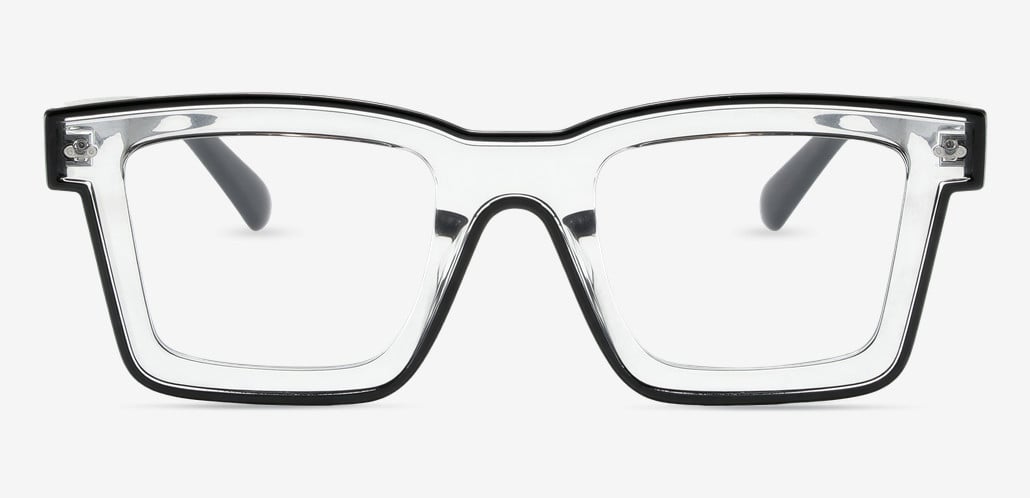
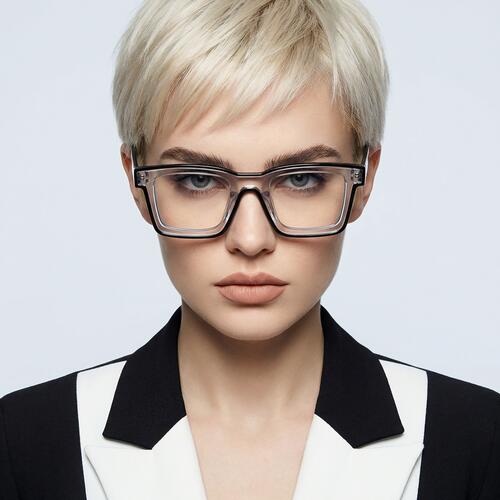
Deep · thick · dark
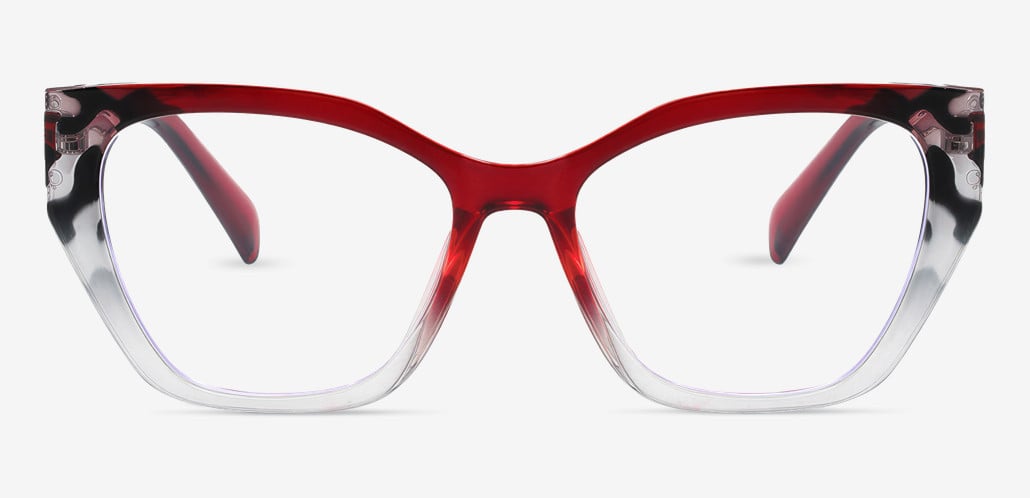
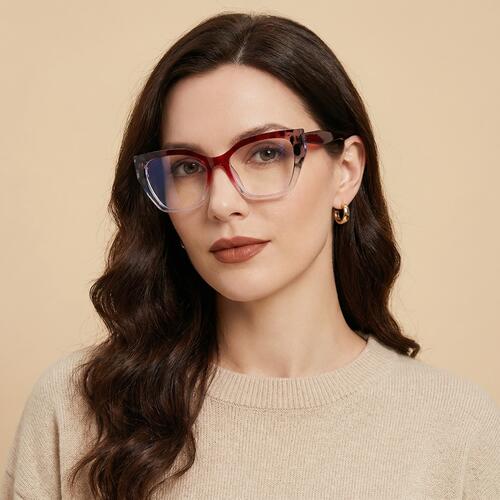
Shallow · thin · low-contrast
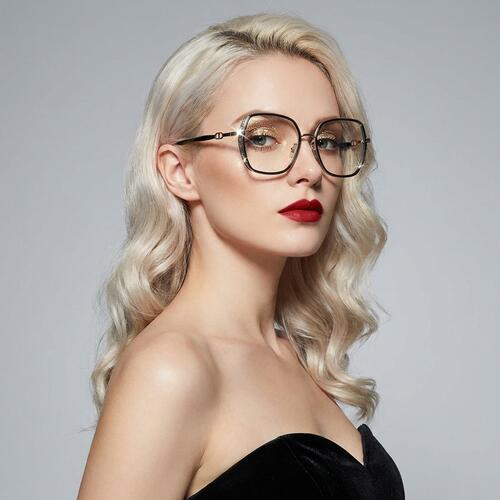
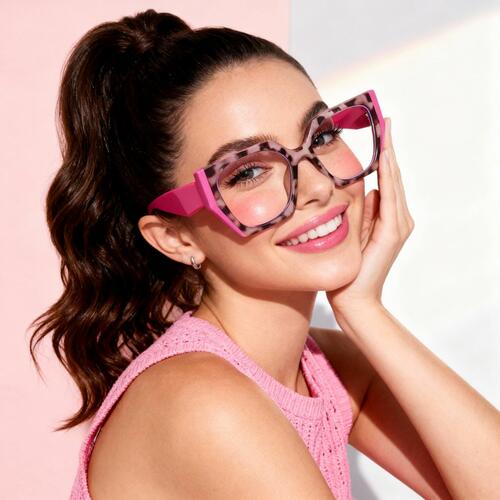
LeftTwo separate lines: frame edge, then jaw.
LeftThe frame edge and the jaw have merged into one band.
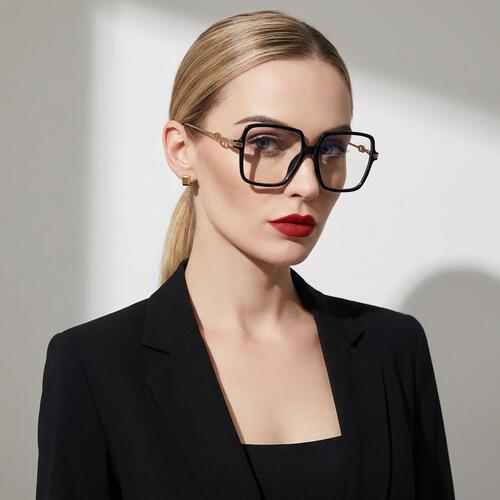
RightTwo separate lines: frame edge, then jaw.
RightStill two separate lines. The shape did not change — the rim weight did.
Do the same thing with your own face. Take a straight-on photo, front lit, no angle. Then pinch it down to thumbnail size on your phone, or step back from the screen until the detail disappears.
If the bottom of the frame and your jawline merge into a single dark horizontal band, you have your answer — and it is the answer the rule was trying to warn you about. If they stay visibly separate, the frame is fine and you can stop worrying about what shape it is called.
This works in the other direction too. Some frames that look aggressively angular at full size vanish into nothing at thumbnail scale, because the rim is thin or the colour is close to skin tone. Those are the “square” frames that quietly work on square faces, and they are invisible to any rule based on shape alone.
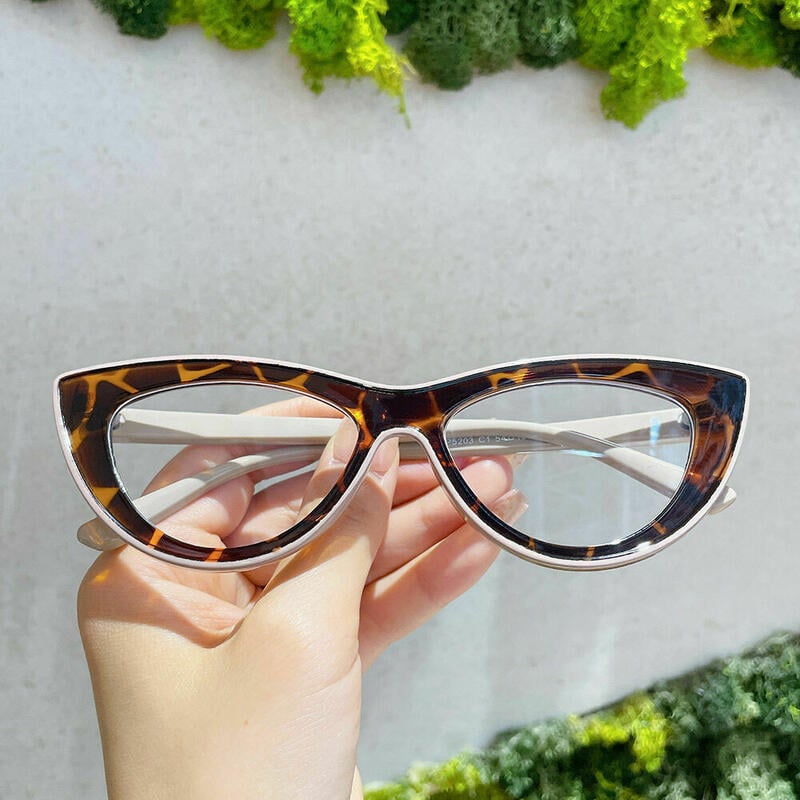
What the shape-based collections are actually doing
Most pages selling glasses for a square face are filtering a catalogue by frame shape and presenting the result. Round, oval, cat-eye — in. Square, rectangle — out. It is a reasonable shortcut and it will get you somewhere decent.
But it filters on the one variable that turned out to be least decisive. It removes frames that would have worked and keeps some that will not. A deep, heavy, dark round frame with a low bottom edge is not automatically better on a square face than a thin metal rectangle with softened corners. The taxonomy says otherwise; the photo test says what it says.
The more useful filters are the ones almost nobody offers: rim weight, lens depth, and total frame width against your own. Aoolia’s glasses for square face collection is grouped by how much softening each frame actually delivers rather than by shape category alone — so angular frames stay on the page, labelled as what they are, instead of being quietly filtered out. Every product page lists total width, lens width, bridge and temple length, and most frames can be previewed with Virtual Try-On. Combined with the shrink-it-down test above, that gets you a real answer in a couple of minutes.
So — can you?
Yes, with conditions, and the conditions are specific enough to be useful.
Keep one angular signal rather than four. Favour a thinner rim or a lighter, lower-contrast colour if the corners are sharp. Check that the frame is at least as wide as your cheekbones. Check where the bottom edge lands relative to your jaw, because that is what the entire rule was actually about. Then look at a thumbnail of yourself and trust what you see over what you read.
The rule was never wrong so much as it was finished too early. It identified a real effect and then, somewhere between styling manuals and product filters, turned a description of a mechanism into a ban. Mechanisms have conditions. Bans do not.
See where a frame’s bottom edge lands, before you buy it.
Aoolia’s square-face collection is sorted by how much softening each frame gives you — from the roundest shapes to angular frames kept on the page on purpose. Full measurements on every product, and Virtual Try-On on most.
Shop glasses for square faceA note on what this article does not claim: face-shape systems are a retail navigation tool, not a taxonomy anyone validated. Most faces do not sort cleanly into six categories, the boundary between “square” and “rectangle” is drawn by whoever is writing the guide, and the advice attached to each one is inherited convention rather than tested finding. It is a useful starting point. It was never meant to be the last word on what you are allowed to wear.