
Why blue is the trickiest color to buy — and the easiest to wear
Two things are true about blue sunglasses at the same time, and they pull in opposite directions.
The first: blue is one of the most universally flattering frame colors there is. It sits comfortably on warm and cool complexions alike, it doesn't fight your hair or eye color the way some warmer shades can, and it reads as a deliberate choice rather than a costume. If you want color but you're nervous about it, blue is the safest place to start.
The second: blue is the color shoppers most often regret. The reason is that "blue" is doing a lot of jobs. A deep, slightly translucent navy whispers; an electric cobalt shouts; a glossy mid-blue can land anywhere between sporty and cartoonish depending entirely on what it's made from and how it's finished. People pick the hue they fall for on screen, never define what they want it to say, and are then surprised when it says the wrong thing.
So before we talk about shade or shape, we have to talk about the thing that quietly decides everything.

Blue is a material decision before it's a color decision
Take one exact blue — say a deep ocean navy — and produce it in three different frame materials. You'll get three frames that photograph as "navy" and feel like completely different products in your hand and on your face. This is the single most useful thing to understand before you buy, so it's worth a real walk-through.
Acetate: where blue looks expensive
Acetate is a plant-based plastic made from cotton fibers and wood pulp, and the key fact for our purposes is how it gets its color. Acetate frames are cut from sheets that are already colored — the blue is layered and fused into the material itself and runs all the way through, rather than being painted on top. That's why a good acetate blue has depth: you can get translucency, subtle gradients, and a glassy polish that cheaper plastics simply can't fake. It also has a satisfying density in the hand that people read, instantly and unconsciously, as "quality."
In blue specifically, acetate is what makes navy look grown-up and a brighter blue look intentional instead of childish. The trade-offs are honest ones: acetate is heavier than the alternatives, it can crack if you drop it on concrete, and it's sensitive to heat — leaving an acetate frame on a hot dashboard is the fastest way to warp it. If you want a blue pair that reads premium and you're willing to treat it with a little care, this is the material.

Metal: where blue looks minimal and sporty
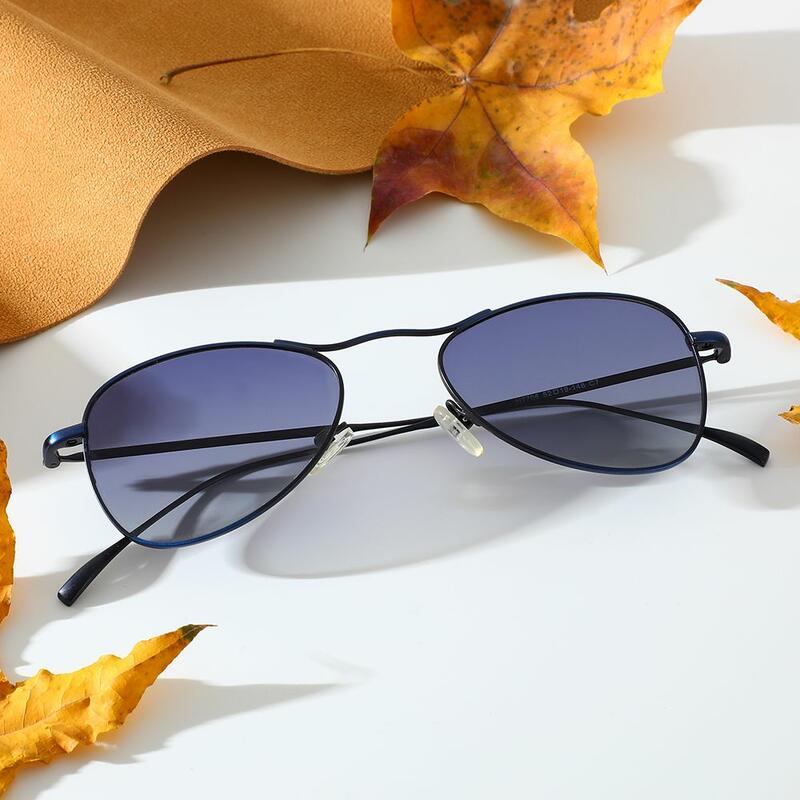
Metal frames take a different route to color. Instead of color running through the material, it's applied as a finish — anodizing on aluminum, or a coating on steel and titanium — over a thin, lightweight profile. That thinness is the point. A blue metal frame is usually a wire aviator, a slim rectangle, or a barely-there rim, so the blue shows up as an accent line rather than a bold block. It reads clean, technical, a little sporty, and it disappears into a professional setting far more easily than a chunky colored plastic.
Metal also bends to a precise fit at an optician's bench and develops a quiet patina over years of wear. The thing to check is the finish quality, because coated color is the part that can chip or wear on a cheap pair. On a well-made frame, blue on metal is the most understated way to wear the color.
TR90 and injection plastic: where blue gets light, tough — and sometimes cheap
TR90 is a nylon-based thermoplastic that's injection-molded, which means the color is mixed into the raw material before it's shot into the mold. The result is a uniform, solid hue all the way through and a frame that is remarkably light, flexible, and nearly indestructible — you can sit on it, drop it, leave it in a hot car, and it shrugs it off. For active wear, kids, travel, or anyone hard on their things, this is the practical winner.
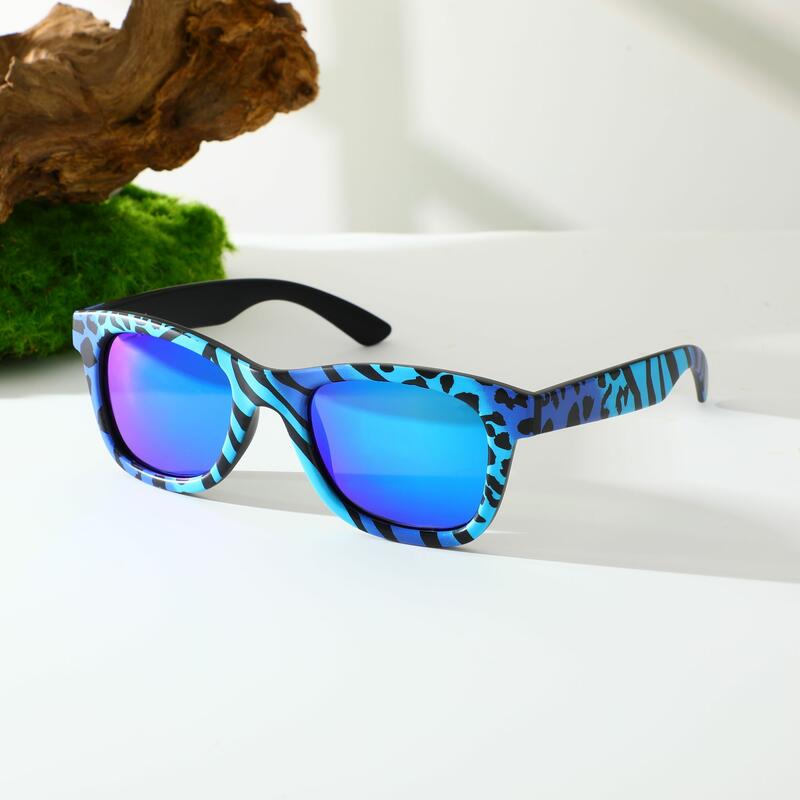
The aesthetic catch is the flip side of the same process. Injection molding can't reproduce acetate's layered depth or translucency, so the finish tends toward a flat matte or a uniform gloss. Done well, that's a clean, modern look. Done cheaply — in the generic plastic that lives at the very bottom of the market — that same uniform glossy blue is exactly what reads as "toy." If a blue pair looks plasticky in photos, this is usually why. The fix isn't to avoid the material; it's to buy it from somewhere that finishes it properly.
The takeaway: decide what you want your blue to signal — premium and expressive, minimal and sporty, or light and bombproof — and let that pick your material first. Then choose the exact shade within it. Do it in that order and the drawer-of-regret problem mostly disappears.
The wardrobe test, not the face test
Most sunglasses guides will now hand you a face-shape chart and a skin-tone matrix. For blue, that's the wrong second question. Blue flatters such a wide range of faces and complexions that the variable which actually predicts whether you'll wear the pair isn't your face — it's your closet.
So run a quick test. Picture the clothes you reach for most. What's the dominant color?
If you live in denim and neutrals — black, gray, white, navy, tan — blue is the easiest possible add. A navy or slate frame functions almost like a softer black and goes with everything you already own; a brighter blue gives you a clean pop against all that quiet. This is the lowest-risk scenario, and it's most people.
If your wardrobe leans warm — olive, rust, camel, mustard, lots of brown — blue becomes a deliberate contrast rather than a match. It can look fantastic, but it's a statement every time, so lean toward a deeper, slightly muted blue that complements warm tones instead of fighting them.
If you wear a lot of color and pattern already, the move is restraint: a quieter navy keeps the frame from competing with everything else going on.
This is also the honest answer to "will blue go with my stuff?" — try the pair against the three or four outfits you actually wear in a normal week, not the one aspirational outfit you wore once. If it works with your real wardrobe, you'll keep reaching for it.

Frame blue, lens blue, and blue light — clearing up the confusion
"Blue sunglasses" is one of the most genuinely confusing searches in eyewear, because it can mean three unrelated things. The 30-second version:
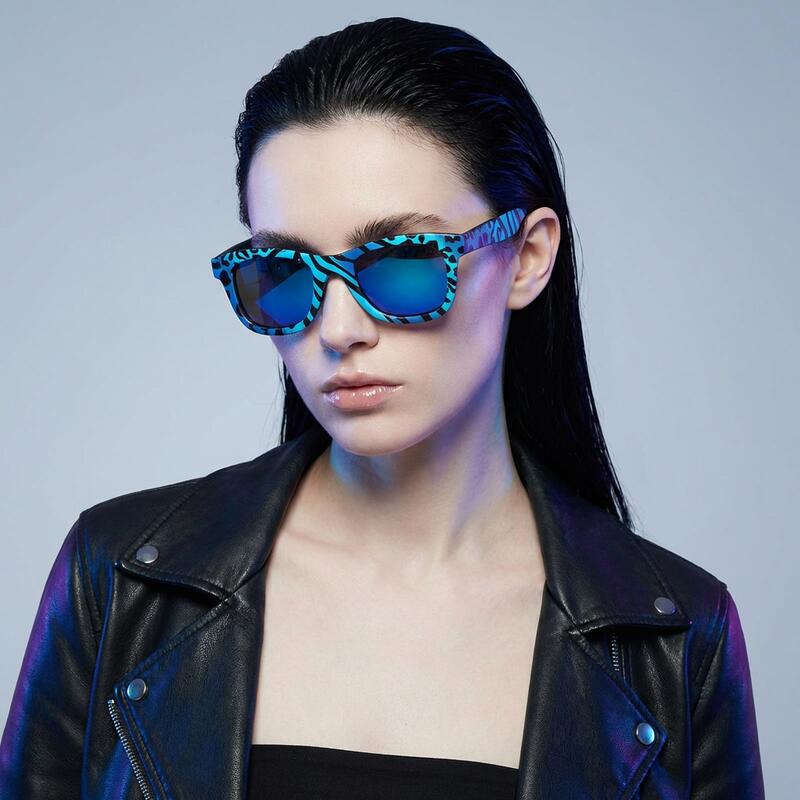
Blue frames — the frame is blue, the lenses are a normal sun tint. This is what most blue sunglasses are, and what most of this guide is about.
Blue lenses — the tint in the lens is blue or blue-mirrored. A real but smaller category.
Blue-light glasses — clear or lightly tinted lenses for screen use indoors. These are not sunglasses at all.
The first two are easy to sort out by looking. The third is worth being firm about, because the marketing around "blue light" muddies it constantly. Sunglasses do block some blue light outdoors as a side effect of UV400 protection, but they are built for the sun, not your laptop. If your actual goal is reducing screen glare at a desk, you want dedicated blue-light glasses with clear lenses, not sunglasses. Different tool, different job.
That leaves one thing the shopping pages rarely explain honestly: what does a blue lens actually do to your vision? Worth knowing if you're tempted by a blue-mirror pair.
A blue tint lets relatively more blue light through and mutes warm colors, so the world looks cooler and a little more subdued through them. That can be genuinely pleasant in haze, fog, light snow, and moderate brightness, and — this is the important part — a blue lens protects your eyes just as completely as any other tint, because UV protection comes from the lens treatment, not the color. What a blue lens does not do is sharpen contrast the way a brown or gray lens does; if anything, a darker blue can flatten it slightly. So a blue lens is mostly a style and comfort choice, not a performance upgrade. For pure glare-cutting in harsh sun or for driving, gray and brown lenses are the more reliable picks. We'd rather tell you that than sell you a story about blue lenses doing things they don't.

Blue across the shapes — and who it's for
Color and shape interact, so here's how blue tends to land across the frame styles you'll actually find:
Blue aviators are the gateway. The thin metal and double bridge keep even a bold blue feeling classic rather than costume — the easiest bold blue to pull off.
Blue square and rectangle frames read modern and a touch architectural; in acetate they carry real presence, which is great if you want the frame to be the statement.
Blue round frames lean creative and vintage; a muted blue keeps them grounded, a bright blue pushes them playful.
Blue cat-eye turns the color up — it's already an expressive shape, and blue amplifies that into a clear fashion choice.
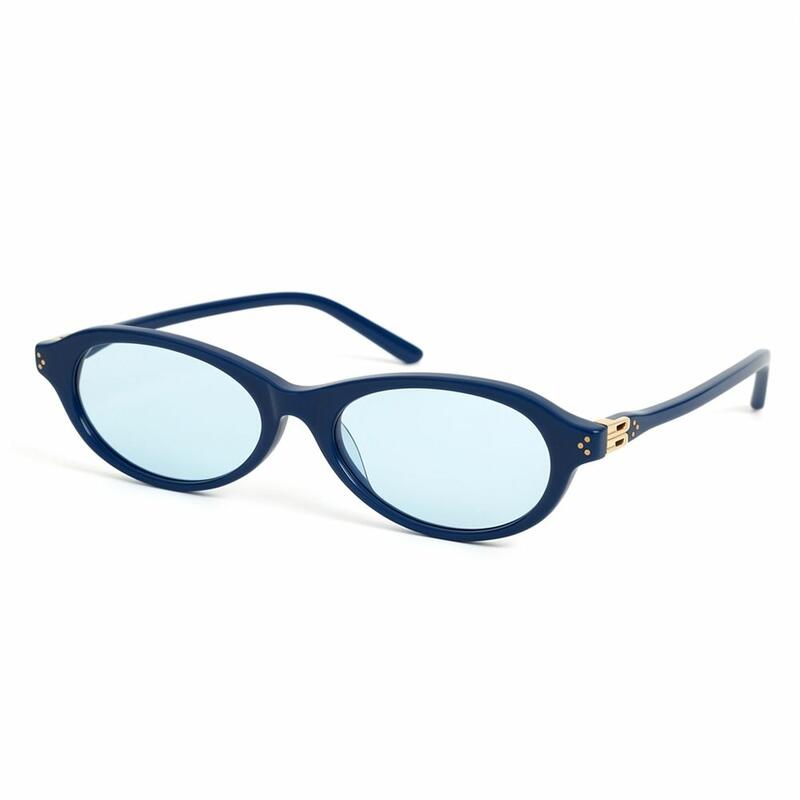
Blue oval is the quietest of the bunch, a soft and easygoing way to wear color.
"Is blue too much for men?"
No — and this is the most common hesitation we hear, so it deserves a straight answer. Blue is one of the most wearable colors in menswear, and the entry point is simple: a navy or slate metal frame. It behaves like a neutral, pairs with everything from a suit to a tee, and never announces itself as "colored sunglasses." From there, men who want more can step up to a deeper acetate blue. The toy-like associations people worry about come from cheap glossy plastic in bright shades, not from blue itself. Choose a grounded shade in a good material and it simply reads as well-dressed.
Before you buy: the practical layer
A blue frame is a slightly bigger commitment than a black one, so it's worth previewing properly. A few things to settle before checkout:
UV first, always. Whatever the frame or lens color, the lenses must block 100% of UVA and UVB — full UV400. A dark tint with no UV protection is worse than no sunglasses, because it opens your pupils while letting damage through. Every Aoolia pair is UV400 regardless of color, but it's the one spec to never compromise on anywhere.
Use virtual try-on. Blue is exactly the kind of purchase that benefits from seeing the frame on your own face before you decide — it tells you in seconds what a product photo on a stranger never will. Aoolia's virtual try-on is free; use it on two or three shades and let your face cast the deciding vote.
Going prescription? Almost any frame in the collection can be made into prescription sunglasses — single-vision, bifocal, or progressive. You don't trade the color for the correction; you get both.
Then mind the material's quirks. If you chose acetate, keep it off hot dashboards and store it in a case — heat is its one real enemy. If you chose coated metal, clean it gently so the finish stays put. TR90 you can basically forget about, which is part of its appeal.
Get the material right for your life, pass the wardrobe test, and confirm the UV, and a blue pair stops being the impulse buy that hides in a drawer and becomes the one people compliment.
Frequently asked questions
Are blue sunglasses still in style?
Blue has moved well past novelty into a mainstream frame color, and it isn't tied to a single trend cycle the way some shades are. Navy in particular behaves like a neutral and stays wearable year after year; brighter blues come and go in intensity but never really leave. It's a safe long-term choice, not a fad purchase.
What do you wear with blue sunglasses?
Almost anything, but they're easiest with denim and neutrals — black, white, gray, tan, and navy. Against a warm wardrobe (olive, rust, camel) blue becomes a deliberate contrast, so lean to a deeper, slightly muted shade. The reliable test is to try them against the outfits you actually wear in a normal week.
Are blue-lens sunglasses good for driving?
They're acceptable in moderate light, but they're not the best choice for it. Blue lenses don't enhance contrast the way gray and brown do, and a very dark blue can slightly flatten it — not what you want when reading the road. For driving, gray or brown tints are the safer pick; save blue lenses for everyday and lighter conditions.
Do blue sunglasses look good on men?
Yes. Start with a navy or slate metal frame, which wears like a neutral and suits everything from formal to casual, then go bolder in a quality acetate if you want more presence. The "too much" worry usually comes from cheap glossy plastic, not from blue as a color.
Will a blue acetate frame fade over time?
Acetate's color is fused through the material rather than coated on, so it holds up well and resists the kind of surface fading you can get on cheaply painted frames. Its real vulnerability is heat, not light — keep it out of hot cars and away from direct heat sources and the color stays true for years.
Are blue sunglasses good for bright sun?
The frame color is irrelevant to sun performance; what matters is the lens. Any Aoolia pair gives full UV400 protection in bright sun. If you specifically chose blue lenses, they're fine for general bright-light wear, but for the harshest glare a gray or brown tint will cut it more effectively.