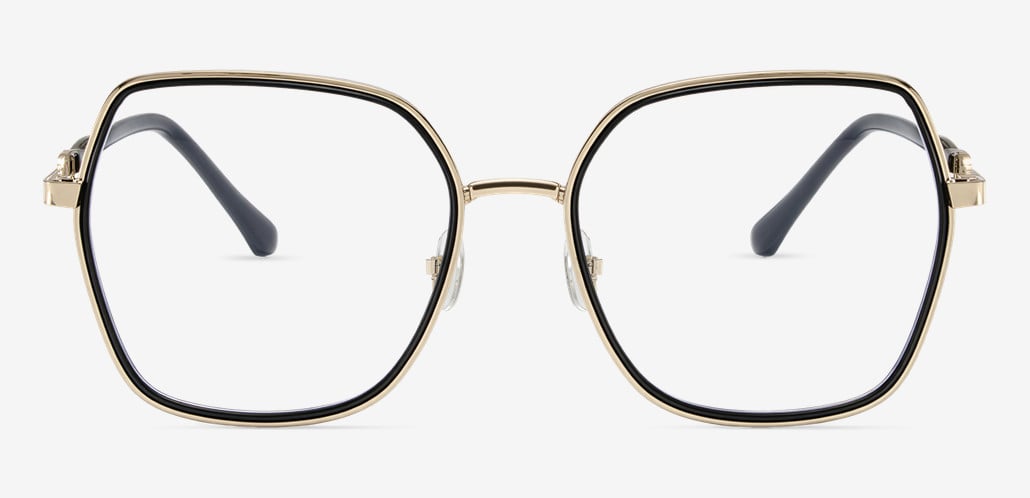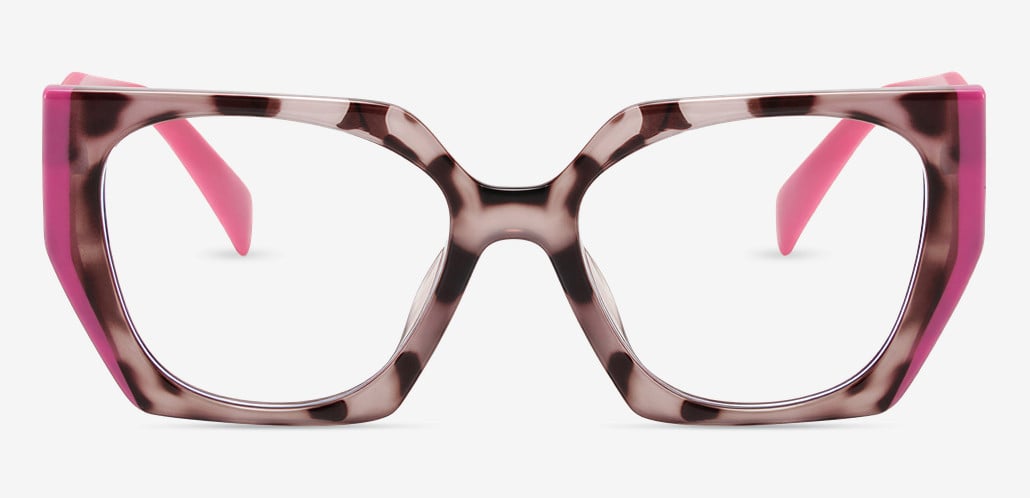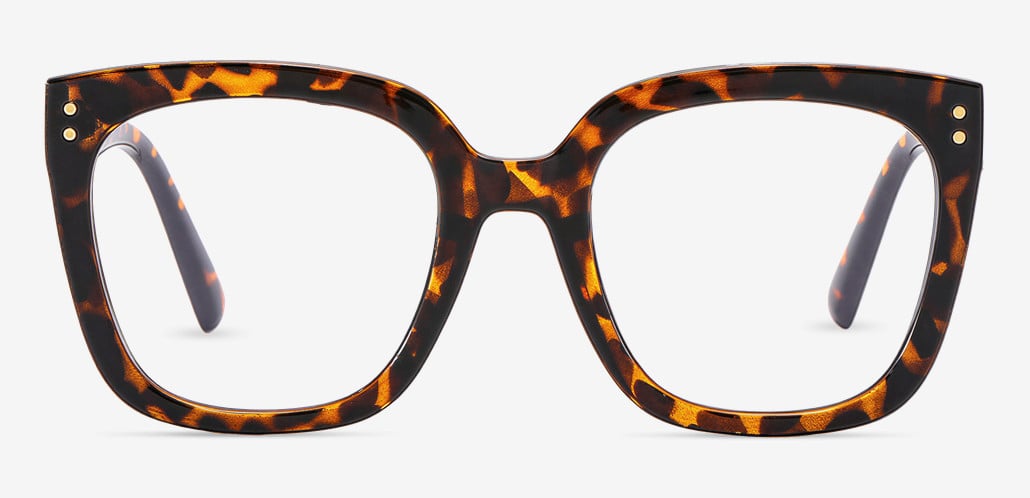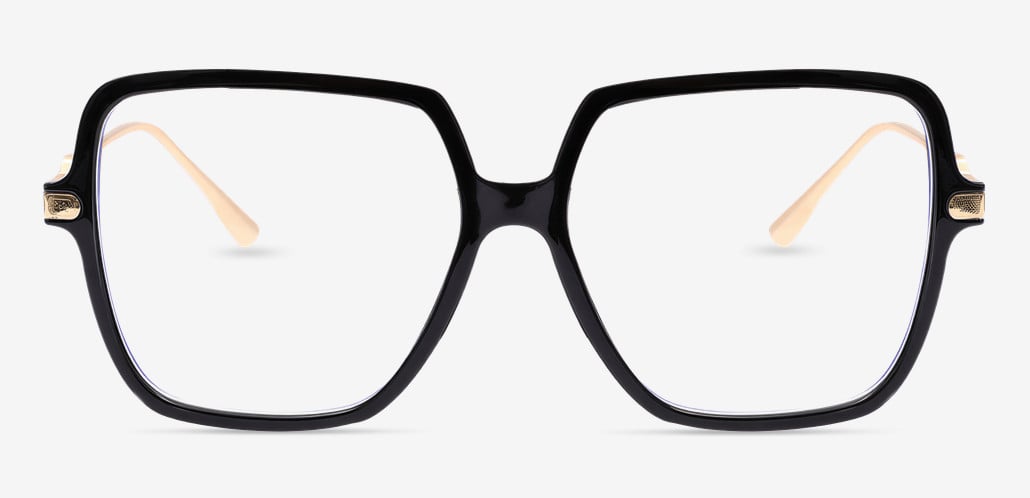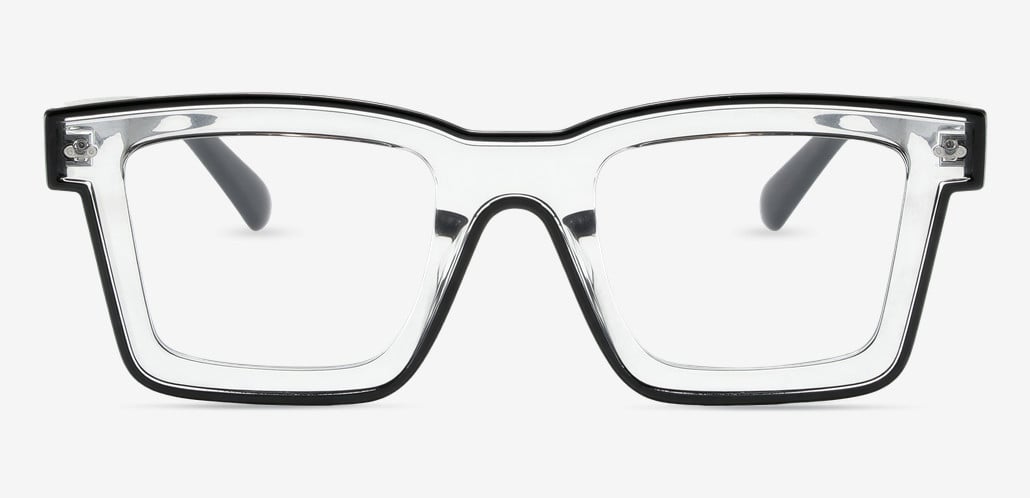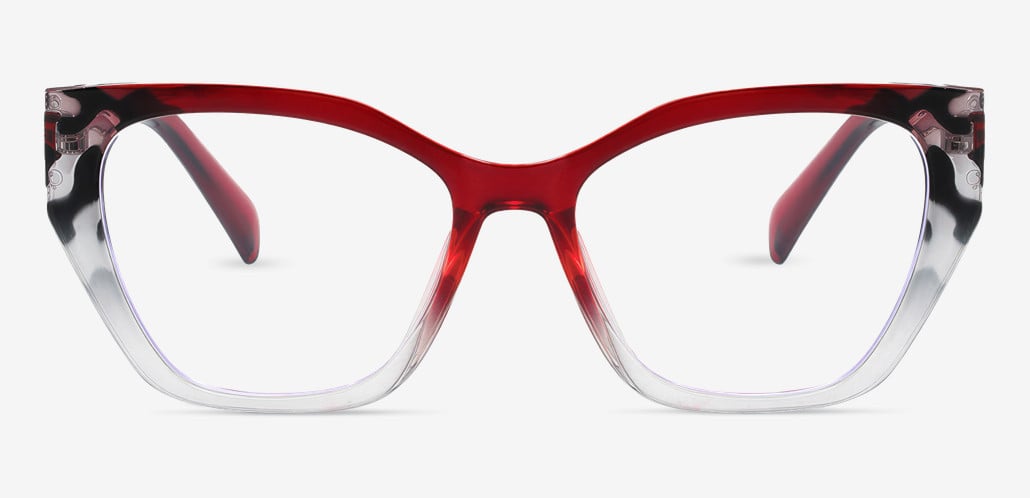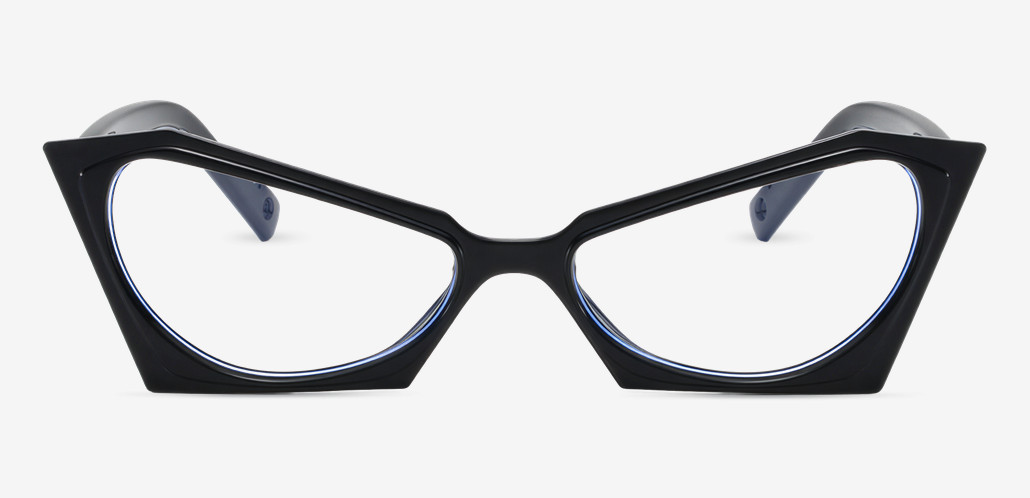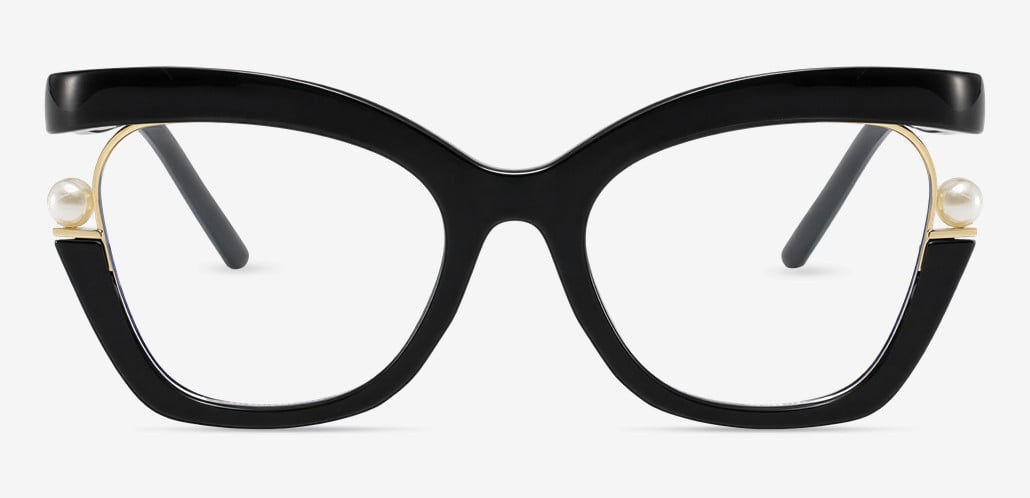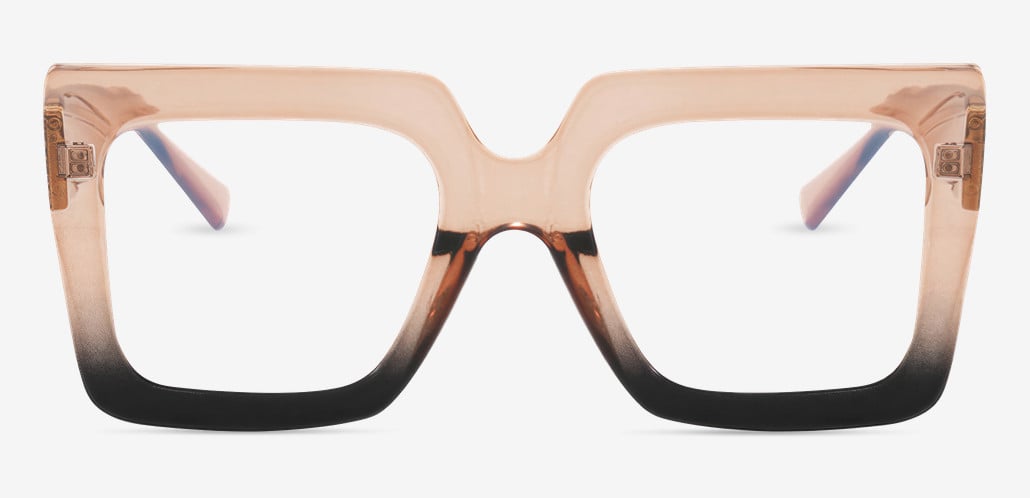

Search "oversized glasses" and you will find a hundred pages telling you that bigger frames make a statement, suit most face shapes, and are having a moment. Almost none of them tell you where the ceiling is. That's the part that matters, because oversized frames don't fail gradually. They fail at one specific point, in one specific way, and it's usually not the failure people are watching for.
The good news is that the ceiling is measurable, it's personal, and you can find yours in about ten minutes using a pair of glasses you already own and a credit card.
First, what the numbers you already have actually mean
Pick up any pair of glasses and look along the inside of the left temple arm. You'll see something like 55□18-145. This is the boxing system, the international convention for describing frame size, and it gives you three numbers:
- Lens width (55) — the widest horizontal measurement across one lens.
- Bridge width (18) — the gap between the two lenses at their closest point.
- Temple length (145) — the arm, measured from hinge to tip including the bend.
The small square between the first two numbers isn't decoration. It signals that these are boxing-system measurements rather than the older datum system, which measured lenses differently and produced numbers a few millimeters apart. It's the reason a 55 on one pair means the same thing as a 55 on another.
Two things are missing from that stamp, and both of them matter more for oversized glasses than anything that's there.
Missing number one: total frame width
Adding the printed numbers together gets you close but not there. Two lens widths plus the bridge — 55 + 55 + 18 = 128 — leaves out the rim thickness, the hinge barrels, and the flare of the end pieces. Real total width on that frame usually lands somewhere between 136 and 144 mm. Two frames both marked 55□18 can differ by 8 mm across, which is the difference between a frame that grips and one that slides.
Missing number two: lens height
This is the vertical measurement of one lens at its tallest point, sometimes called the B measurement. It is not part of the boxing stamp, it is not required, and most retailers don't publish it. Which is strange, because it is the single number that separates oversized glasses from ordinary ones.
This is why width-based shopping goes wrong. Someone with a broad face buys the widest frame they can find, expecting drama, and gets a frame that fits comfortably and looks like every other pair they've owned. Meanwhile someone with a narrow face buys a genuinely tall frame and discovers on day two that the bottom rim sits on their cheeks every time they laugh.

"Too big" isn't a number. It's whichever ceiling you hit first.
There is no universal maximum. There are five separate constraints, and your personal ceiling is set by whichever one your face reaches first. Two people can buy the same pair of oversized glasses and hit completely different walls.
They're listed below in the order they tend to bite in real life — which is close to the reverse of the order most people check.
Hits first · Set by lens height
The cheek
The most common way oversized glasses go wrong has nothing to do with width. The bottom rim rests against the cheek, and every time you smile the flesh rises and pushes the frame up your nose. Over a day you get frame walk, marks on the cheek, makeup transfer onto the rim, and lenses that fog faster because warm air is trapped underneath.
The mechanic worth knowing: if the bridge fit is the same, extra lens height splits roughly evenly above and below your pupil. So every 2 mm you add to lens height costs you about 1 mm of cheek clearance.
Test it: put on the tallest frame you own, smile as widely as you can, and look at the gap between the bottom rim and your cheek. If it's already touching, you have no headroom at all. If it clears by 4 mm, you can go roughly 8 mm taller before you're back at contact.
Hits second · Set by total frame width
The width line
Oversized frames are supposed to extend past the widest part of your face. That's the look. But there's a point where the temple arms have to bow outward to reach your ears, and once they're bowing, the frame loses its grip and rides forward all day.
As a working range: up to about 6 mm wider than your face reads as deliberately oversized and still holds position. Between 6 and 10 mm you're relying on the nose pads and a good adjustment. Past 10 mm, the frame is wearing you.
Test it: a standard credit card is exactly 85.6 mm long — a defined international standard, so yours is the same as everyone else's. Hold two cards end to end across your face at temple level in a mirror. That's 171 mm of reference; most adult faces land between 125 and 150 mm at that point.
Style ceiling · Set by where the top rim lands
The brow
Tall frames often reach up over the eyebrow. This isn't a fit failure — plenty of the most striking oversized glasses cover the brow completely, and it's a large part of why they read as bold.
The problem is the in-between. When the top rim sits within a millimeter or two of the brow, it slices the eyebrow in half and reads as a mistake rather than a choice. Clearly above or clearly below both work. The narrow band in the middle doesn't.
Test it: this is the one thing a virtual try-on genuinely settles. It won't tell you millimeters, but it will show you instantly whether the rim clears your brow or cuts it.
Comfort ceiling · Set by weight × width
The slide
Bigger frames carry more mass, and they carry it further from the bridge, which multiplies the leverage working against your nose. This is why two frames of identical weight can behave completely differently: the wider one slides.
Rough guide for an adult optical frame with lenses fitted: under 20 g rarely moves. Around 25–30 g is fine on a well-defined bridge and irritating on a low one. Past 32 g at oversized width, you will be pushing the frame up several times an hour unless it's fitted properly.
What raises this ceiling: titanium and TR90 instead of thick acetate; adjustable nose pads, which let you tune both grip and how far the frame sits from your face; and a smaller bridge measurement, which seats more of the weight on bone rather than soft tissue.
Applies to some wearers only · Set by your lenses
The lens edge
If your correction is mild, skip this one. If it's stronger, a bigger lens is a real constraint rather than a theoretical one: the further the lens extends from its optical center, the thicker the edge becomes on a minus lens and the heavier the center becomes on a plus lens. A frame that adds 6 mm of lens width on each side can add noticeably to edge thickness at the temples.
It's also the only ceiling on this list you can buy your way past. Higher-index lens material thins the edge, and a frame with a thicker rim conceals what's left. Both are worth doing before you conclude that oversized glasses aren't an option for you.
Most people check width and ignore height. Then they hit the cheek ceiling, blame the frame for being "too big," and buy something smaller than they actually needed. Check height first.
Finding your own ceiling in ten minutes
You need a pair of glasses you already wear, a ruler with a millimeter scale (or a credit card), and a mirror. The method works because you're calibrating against something with known behavior on your own face, rather than trying to predict from scratch.
- Measure the lens height of your current pair. Hold the ruler vertically against one lens at its tallest point and read the millimeters, rim edge to rim edge. Write it down. This is your baseline.
- Read the stamp inside the temple arm. Note the lens width and bridge. If there's no stamp, measure the lens at its widest horizontal point instead.
- Measure total width. Lay the frame flat and measure from the outer edge of one hinge to the outer edge of the other. This is the number retailers rarely publish and the one that predicts grip.
- Do the smile test. Wearing the frame, smile as broadly as you can and measure or eyeball the gap at the bottom rim. Double it — that's roughly how much extra lens height you can take before contact.
- Note where the top rim sits relative to your brow: above it, below it, or cutting through. If it's cutting through, you already know which direction to move.
- Log the annoyance. Does this pair already slide? Does it leave marks? Whatever already bothers you at your current size will be amplified, not fixed, by going bigger.
You now have four personal numbers and one honest note about what already irritates you. That's more information than any face-shape chart will give you.
A worked example
Take a fairly typical case. Current pair measures 52□17, lens height 38 mm, total width 137 mm. Face width at the temples reads about 134 mm. On the smile test, the bottom rim clears the cheek by roughly 3 mm. The frame doesn't slide, and the top rim sits just under the brow.
Work through the ceilings in order. Cheek clearance of 3 mm means about 6 mm of extra lens height is available — so 44 mm is the practical ceiling, and 42 mm is the comfortable target. Width has more room: at 134 mm of face, a frame up to about 144 mm stays in the deliberate-not-comical range. The brow will get covered somewhere around 42 mm of height, which is a decision, not a problem.
The conclusion is specific and useful: this person should shop for roughly 42 mm of lens height and 140–144 mm of total width, and should be more careful about height than about width — which is the opposite of what they'd have guessed. A frame that's 148 mm wide with a 40 mm lens will feel enormous and behave perfectly. A frame that's 138 mm wide with a 48 mm lens will fit beautifully and annoy them by lunchtime.
You hit one ceiling and still want the frame
Hitting a ceiling isn't always a no. Four of the five have workarounds.
| Ceiling | Symptom | What actually helps |
|---|---|---|
| Cheek | Rim touches when you smile | Adjustable nose pads set higher and further out; a frame with the same height but a shallower bottom curve; a smaller bridge number, which seats the frame higher |
| Width | Frame creeps forward; arms bow | Have the temple arms bent in at the ear bend; choose spring hinges; drop to the next total width rather than the next lens width |
| Brow | Top rim cuts the eyebrow | Move decisively — either a taller lens that clears the brow, or 3–4 mm shorter so it sits clearly below |
| Slide | Constant pushing up | Titanium or TR90 instead of thick acetate; adjustable pads; a proper fitting adjustment, which is free and fixes this more often than a new frame does |
| Lens edge | Thick edges at the temples | Higher-index material; a thicker or darker rim to conceal the edge; a slightly smaller lens width at the same height |
Numbers worth keeping
| Measurement | Typical adult range | What it decides |
|---|---|---|
| Lens width | 46–58 mm | How much lens sits in front of each eye |
| Lens height | 28–48 mm | Whether a frame reads as oversized; cheek and brow contact |
| Bridge width | 14–22 mm | How high the frame sits and where its weight rests |
| Temple length | 135–150 mm | Whether the arms reach comfortably behind the ear |
| Total frame width | 125–150 mm | Grip, slide, and how oversized it looks head-on |
| Frame weight, glazed | 15–35 g | How often you push it back up your nose |
Aoolia publishes lens width, lens height, bridge width and temple length on every product page, including on the oversized glasses collection, which is the whole reason the ten-minute method above is worth doing. Measure once, then shop by number instead of by photograph.
Common questions
What size is officially "oversized"?
There's no regulated definition, which is why the word gets used so loosely. As a practical working line: lens height from 45 mm, lens width from 55 mm, total frame width from 140 mm. Height is the one that carries the look — a wide frame with a short lens reads as a large frame, not an oversized one.
Can oversized glasses be too big for a small face?
Yes, but the failure point is usually height rather than width. Smaller faces tend to have less distance between the pupil and the cheekbone, so they hit the cheek ceiling early. The fix isn't a smaller frame overall — it's keeping the lens height near your measured ceiling while letting the width run generous, which gives you the oversized look without the daily irritation.
Why don't retailers publish lens height?
Because it isn't part of the boxing stamp that manufacturers are used to supplying, so it has to be measured and entered separately for every frame. It's a data-entry cost rather than a secret. When a listing omits it, the most reliable workaround is to find a product photo shot straight-on and compare the lens proportions against a frame whose height you've already measured.
Does a bigger lens actually help you see more?
It gives you more corrected area to look through, which is noticeable when you glance down at a phone or a step and would otherwise be looking over the top of your frames. What it doesn't do is improve sharpness. The clearest part of any lens is near its optical center, and that stays the same size no matter how much material surrounds it.
How do I measure my face width without a proper ruler?
Use a credit card. Card dimensions are set by an international standard at 85.60 mm long and 53.98 mm tall, so any card in your wallet is a calibrated ruler. Held against a mirror at temple level, one card length plus the visible remainder gets you within a few millimeters, which is close enough to choose between frames.
Are oversized frames heavier?
Usually, though material matters more than size. A large titanium frame can weigh less than a mid-sized thick acetate one. Where size reliably works against you is leverage: the same weight sitting further from your nose bridge feels heavier and slides more, which is why adjustable nose pads make more difference on oversized frames than on small ones.
About the numbers in this guide
Frame markings follow the boxing system, the international convention used for eyewear sizing, which specifies lens width, bridge width and temple length but not lens height. Credit card dimensions are fixed by the ISO/IEC 7810 ID-1 standard at 85.60 × 53.98 mm.
The ranges given for lens height, frame width and frame weight are typical values for adult optical frames, not standards. They're offered as calibration points for comparing against your own pair, and individual frames sit outside them regularly. The measurements on any specific frame are the ones published on its product page.
This guide covers frame geometry and fit. It isn't a substitute for an eye examination or for advice about your own vision.